With my vacations at a near end, I have to travel to Quebec city to visit some friends. It will also be an opportunity to make my weekly radio commentary in studio at CHOI Radio X (in french). However, in a rare turn of events, I will be spending a large segment of the show (maybe the entire show) in studio as a guest. If you wish to listen to the interview, please visit www.radiox.com
Month: August 2011
Stalin’s darkroom
In the research for my piece on the commemoration of the dissolution of the Soviet Union, I fell on a 1998 article by historian Robert Conquest that I had never had the chance to read. In fact, neither in Harvests of Sorrow nor in The Great Terror did I find a mention of what he reports in the article. It makes a novel observation about the Soviet Union and … photography.
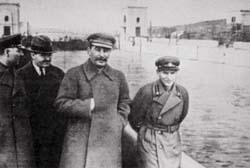
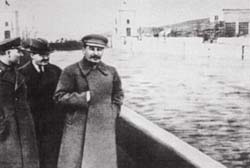
The purges of Stalin caused problems for official propaganda. If an individual that was sent to Kolyma died there and happened to be featured on an official picture, how to solve this problem to say that he never existed. Simple, you alter the pictures. In reviewing David King’s The Commissar Vanishes: The Falsification of Photographs and Art in Stalin’s Russia (that I have ordered because of this review), Conquest publishes some of the pictures of this “darkroom manipulation”. Here is one, I think it is quite telling.
CÉGEP en anglais
Note to my American and British Readers : This post is in french, it concerns the topic of linguistic laws in Quebec and the proposal to make it compulsory for individuals whose parents went to french school to go to college in french.
Alors que la rentrée collégiale approche, des collègues à moi se sont mis à demander une extension de la loi 101 au niveau collégial. Mathieu Bock-Côté, un de ceux qui a défendu l’idée alors que le sujet de la langue était un thème politique avec peu d’attrait, dirige la cabale intellectuelle en faveur de l’idée. De son point de vue, les allophones ne s’intègrent pas et une manière de les intégrer selon Bock-Côté serait de les forcer à aller au CÉGEP en français au lieu de leur laisser l’option de choisir entre l’anglais et le français. Malheureusement, la position de mon collègue ne tient pas la route puisqu’elle se base sur une crise complétement fictive.
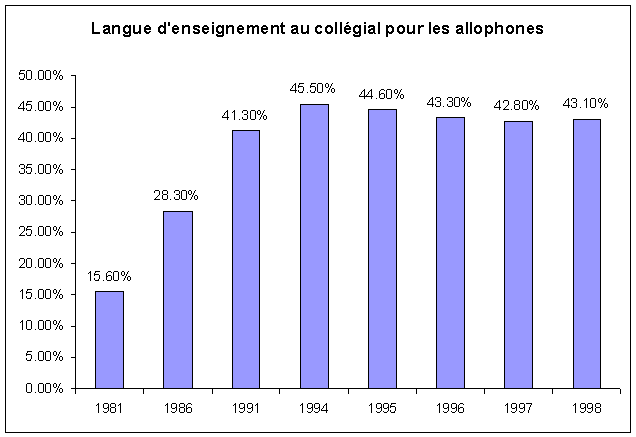
- Les allophones sont davantage attirés au CÉGEP francophone qu’au CÉGEP anglophone. Le graphique plus bas témoigne de ce fait (la série et la source est disponible dans la page “data sets” de ce site).

- Notons qu’en 1981, seulement 15.60 % des allophones optaient pour le CÉGEP en français, alors qu’en 1998 on parlait d’environ 50 %. Notons aussi qu’il existe une divergence entre les séries statistiques à cause de la nature des échantillons composées, mais les deux (disponibles ensemble dans la page “data sets”) illustrent la même tendance.


Ticket scalping : why it is good
In Quebec, the provincial government is attempting to restrain ticket reselling, more commonly known as scalping. In the eyes of the government, scalping deprives consumers of the tickets they so ardently want. However, the regulation of this activity might in fact harm consumers more than it could help them. It may also even reduce the “supply” of cultural, artistic and sporting events. I outlined the reasons why for this in this interview I gave to the Journal de Montréal (french). Here is more complete explanation of my argument :
- The supply of seats at an event is limited, the demand can be illimited;
- Evaluating the correct price at which consumers desire their tickets is a tricky task for the organizer of the event. If he charges too high, he won’t be able to fill up his arena, stadium or theater. On the other hand, if he charges too low, he could not cover his costs. Hence, the evaluation of the “correct” price is an arduous and risky task for the organizer;
- To cover his costs and make a reasonable profit, the organizer will charge a low price that will bring him closest to filling up the room;
- The risk is hence shifted on scalpers whose sole task is to collect as much information as they can about the extent of demand and then try to make a profits;
- In this entire process, consumers are the biggest winners since tickets are not allocated on a first-come-first-served basis. Instead, they are allocated on the basis of what consumers are ready to pay. Those who will buy the tickets at the higher price caused by the scarcity of places will be those who value at that price. Hence, arenas, stadiums and colloseums will have less empty seats as was observed when scalping was deregulated for the NHL in seven American states;
- It also provides consumers with more flexibility about when to buy tickets or about reselling them if they have changes in plans;
- Without scalping, there are two possible outcomes. The first being a reduction in the “supply” of cultural events since there are more risks for organizers. The second being, if we wish to maintain the supply of cultural events, is to increase subsidies to those events. However, this is costly and less efficient that the aforementionned concept of scalping.
In short, this is the argument in favour of scalping and in favour of letting it continue freely;
Peak oil was in 1973?
According to proponents of the so-called peak oil theory, we will one day run out of petroleum. Nevermind that there was once a “peak guano” theory referring to our harvesting of guano (litterally bird shit…). Recent increases in the price of an oil barrel has sparked a resurgence of this theory. However, production matters very little since we react to prices by either shifting progressively to new technologies or by consuming more efficiently.
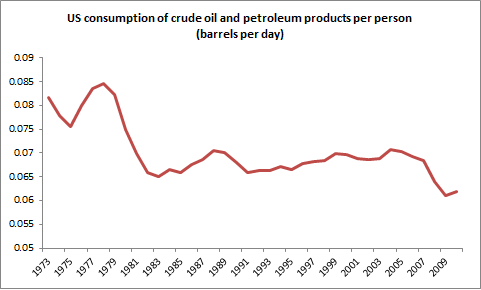
So let us look at consumption of oil per person as illustrated in the graph below that I have made using data provided by the Energy Information Agency. It is interesting to note that drops in consumption occur after important surges in prices (the 1970s and the 2000s). In a sense, can “peak oil” really occur if we either find new and more efficient energy technologies or if we consume oil so efficiently that we look like a mosquito in front of a dozen olympic pools of blood?
Peak oil is a theory whose days have passed and ought to be burried behind the barn.
 Vincent Geloso