Following discussions on a previous post concerning wartime prosperity, I decided to make a follow-up on wartime accounting of economic output. My argument rests on the idea that wartime spending does not increase economic growth, it merely takes ressources away from the private sector to build military ressources. Moreover, I also argue that military goods cannot be considered as valuable goods – especially since many of them are intermediary goods. This is why I believe that output figures must be corrected during wartimes to exclude military outlays.
In this way, I make the same claim that Robert Higgs did (himself inspired on Simon Kuznets’ work) but for Canada. To defend this methodological approach, Higgs quotes Kuznets who said that “a major war magnifies these conceptual difficulties, raising questions concerning the ends economic activity is made to pursue; and “the distinction between intermediate and final products.” In the end, he asserts that the “crucial question: does war spending purchase a final good and hence belong in GNP, or an intermediate good and hence not belong.” This is why Higgs calculates a new series of GNP data points which exclude all military expenditures – something that others economists like William Nordhaus and James Tobin have also done as Higgs points out.
In this spirit, I have recalculated GNP figures for Canada and compared them with the United States figures that Higgs provides and produces. First, here is the non-corrected figures

Sadly, my data from the Historical Statistics of Canada are not as detailled as those Higgs – I do not have spending on munition productions, constructions, maintenance etc. I only possess numbers for national defence per se. So I decided to remove the entire national defence outlet from GNP. Hence the following graphic:
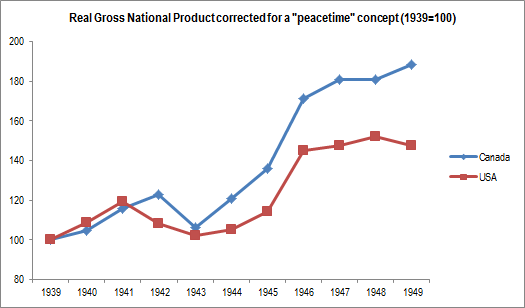
In both cases, you can see that during wartime, GNP did not increase as much as the official figures did and the increase is fastest after the war. But even there, I think the corrected figures fail to convey information about real production. The vast majority of goods produced in the economy were reallocated to defence (foodstuffs, oil, plastics, glass etc.). This meant rationing through tickets, queues and favoritism. It also meant that ressources were not allocated as efficiently as they could have been. This means that our price indexes might be woefully inaccurate. For example, when we look at deflator constructed by Milton Friedman and Anna Schwartz in A Monetary History of the United States, we can see that the official consumption figures are out of sync with reality. Friedman and Schwartz’s deflators show that consumption shrank in the United States during the war.
Note: The data is available in my data sets page


 Vincent Geloso