A note on austerity and aggregate supply

In a recent paper in the Cambridge Journal of Economics, Daniel Kuehn storms into the face of austerity hawks by arguing that the 1920-21 recession – heralded by many as a poster-boy for austerity measures – is not applicable.

Strangely, even if I am an austerity hawk, I agree with his view. In short, Kuehn that the recession of 1920-21 was the result of a contraction in the aggregate supply caused by a series of strike and the reallocation of ressources following the end of the Great War which was hampered by numerous regulatory and fiscal controls.

Kuehn is right that it was indeed an issue linked with liberating aggregate supply from the chains that held it back.  Indeed, Nicholas Crafts and Kent Matthews, in their respective studies of the Great Depression in the United Kingdom, found that it was the ability of the supply side to adapt rapidly (mainly in housing construction) which allowed the country to exit the recession earlier than the United States.

However, when he claims that austerity measures probably had no effect in the short run, they surely had an effect in the long run.  The fiscal consolidation that began under Harding and continued under Coolidge sent a strong signal to financial markets about the commitment of the government with regards to its huge debt obligations and the fiscal environment it would create to repay them. In the long run, the austerity measures allowed to liberate resources in the private economy and reduce tax rates. In turn, this allowed the economy to grow even more.

In short, as I have argued elsewhere (albeit in French), austerity measures are not a driver, they are complements to supply side liberalization in order to sustain long term growth. Rather than arguing about austerity measures, we should argue about where to cut first in complement with liberalization policy.

Naissances hospitalisées au Québec, 1931-1957

Parmi les indicateurs important du développement (et de santé publique), on retrouve le pourcentage de naissances qui sont hospitalisées. Il ne s’agit pas de la mesure la plus importante et la plus puissante, mais lorsqu’elle est combinée à un éventail de données démontrant une amélioration de la qualité de vie, elle contribue à illustrer les débordements positifs de la croissance économique dans des domaines d’ordre social. Comme par hasard, j’ai des données sur l’écart des naissances hospitalisées au Québec relativement au reste du Canada. En 1931, moins de 10% des femmes québécoises accouchent dans des hôpitaux. Le Québec est alors dernier, derrière le Nouveau-Brunswick à 12%. Après avoir vécu un bond important pendant la guerre, comme toutes les autres provinces, le Québec effectue un rattrapage impressionnant jusqu’en 1957 et l’écart se ferme progressivement (en ratio).  Il demeurait dernier, mais les progrès étaient collosaux. Considérant la vitesse des changements entre 1951 et 1957, je suis convaincu que l’obtention de données pour 1958 à 1960 renforceraient cette tendance.

The European Origins of Development

Today, at the National Bureau of Economic Research, William Easterly and Ross Levine have published a paper on the impact of European settlements on future development. Their results are rather robust and I believe their analysis to be convicing (and will probably feed the likes of Niall Ferguson). However, I am always perplexed by one very simple item: how are institutions chosen?

Consider the following: the British attempted to prevent white settlement in India because they felt it would threaten their colonial rule. Instead, they prefered to rule in a system that mixed direct control with indirect control via the princely states. Why?

Colonial institutions are very relevant items in explanining modern economic growth, yet their political economy and the process of their formation is often understudied or taken for granted. For example, why did the British decide to implant a particular set of rules in Quebec after its conquest in 1763 than in its colony of Nova Scotia? What were the constraints for each choices? What motivates constitutional reforms like those seen in 1763, 1774, 1791, 1840, 1848 and 1867 (in the case of Canada)?

Another example can be found in Africa. In an article in Explorations in Economic History, Ewout Frankema noticed that each British colonies spent the revenues they collected in very different manners. For example Mauritius spent on education and infrastrucutre while the Kenyan protectorate acted as a predatory state where tax revenues were redirected towards white farmers. Moreover, Mauritius developped complex institutional frameworks for the collection of revenues that minimized distorsions on growth while Kenya enacted cheap administration for revenue collection even if it exacted a high cost on the economy. Why and how do such policy choices – which clearly have a long term impact on growth – come to be?

These are all questions that I believe need to be answered more thoroughly. In short, I believe we need to develop a political economy of colonial institutions.

Labor Markets: Two Solitudes (Quebec and Canada)

I have decided to dive into a long debate about Canadian economic intergration since the beggining of the 20th century. According to most of the litterature, Canada developped itself economically but the numerous provinces did not converge, especially with regards to labor markets. There are significant contributions to this debate. Foremost amongst them is the paper by Emery and Coe (2002) in the Canadian Journal of Economics and the integration of labor markets in Canada before 1950.

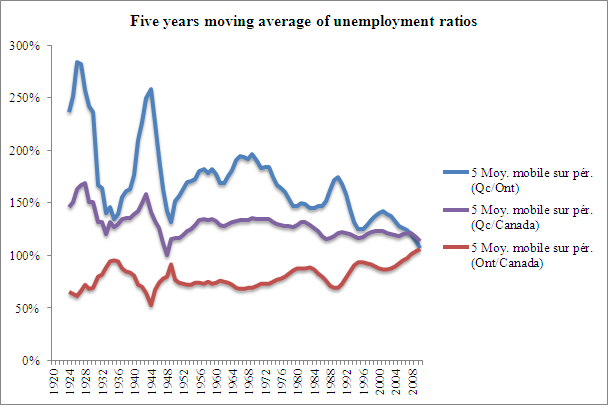
However, the paper by Coe and Emery does not possess any data regarding unemployment before 1950 and uses only real wage rates. Consequently, I have taken the time to collect some data on unemployment rates for the period from 1920 to 2000. Up to 1946, the data used is the month of june of every year for unemployment in trade unions (I also have monthly data for the 1920s) . It provides the following image. I admit that I fail to see any convergence between the two largest provinces and the country as a whole.


If we take a closer look and create a ratio of these data points as a 5-years moving average, we can see that for most of the 20th century, Quebec is unable to catch back on Ontario. Towards the 1990s, it does seem to close the gap with Ontario. However, it seems like Ontario is loosing ground relative to the rest of Canada. Is Quebec convergence the result of Ontario relative slow down?

I think that it is also worthwhile to point out that each time there is a recession, Quebec fares worse than Ontario except for the most recent financial crisis.

Les femmes pendant la Grande Noirceur

Est-ce que les femmes allaient mal pendant la Grande Noirceur au Québec? La réponse est oui! Il est évident qu’en privant des individus de droits contractuels normaux, il y a signe de retardement. Toutefois, il est pertinent de savoir comment les femmes québécoises évoluaient relativement aux femmes d’ailleurs.

Alors qu’en est-il? Il semble que le salaire réel par heure des femmes au Québec n’aille pas augmenté augmenté aussi que celui des hommes entre 1950 et 1960, ce qui pourrait expliquer pourquoi leur taux de participation au travail est en dessous de celui de l’Ontario.

Toutefois, je n’adhère pas à cette hypothèse puisque entre 1950 et 1960, le salaire hebdomadaire des femmes québécoises a augmenté plus vite que celui des femmes de l’Ontario. Par conséquent, une femme qui travaillait au Québec en 1950 obtenait environ 83% du salaire d’une Ontarienne. En 1960, on parle de 90%.

Encore un mythe de la Grande Noirceur qui vient d’être nuancé…