Podcast: The Lightship in Economics?

A week ago, I was interviewed by Garrett Petersen of Economics Detective Radio (my favorite podcast to discover cutting-edge research outside my general fields of interest) to talk about my joint with Rosolino Candela (Brown University) on the economics of the lighthouse, lightships and public goods. The paper is available here and the podcast can be listened to on the website of Economics Detective Radio.


New position: Bates College

On May 31st, I will be leaving Texas Tech University and the Free Market Institute. I will be joining, starting August 1st, the department of economics at Bates College as a visiting assistant professor. I will be teaching macroeconomics and economic history (as a 2:2 course load).

Forthcoming – Measuring Away the Importance of Institutions: The Case of Seigneurial Tenure and Agricultural Output in Canada East, 1851

I have received news that my paper “Measuring Away the Importance of Institutions: The Case of Seigneurial Tenure and Agricultural Output in Canada East, 1851” has been accepted for publication in Social Science Quarterly.  The abstract is below:

This paper argues that the 1851 census of Canada East (the modern-day province of Quebec) requires a set of important corrections. Using corrections based on ethnic origin composition, I demonstrate how significantly wheat and oat yields were underestimated in Canada East. More importantly, we argue that the measurement errors are not randomly distributed and that they are biased against attempts to test the role of institutions. We show how new methods of correcting the data change our interpretation of agricultural efficiency in Lower Canada in the mid-nineteenth century. While this correction may seem minor, it shows that in the past, the data took a form that was biased against numerous hypotheses concerning land tenure institutions.

Forthcoming – Adjusting inequalities for regional price parities: importance and implications

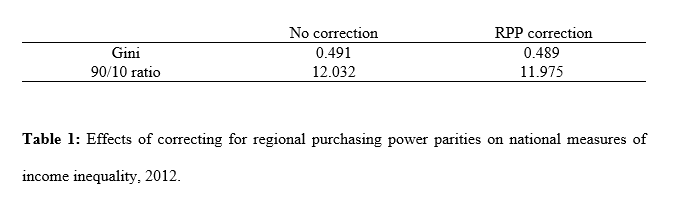
I have received news that another of my article has been accepted. This time the acceptance is from the Journal of Regional Analysis & Policy and the paper was co-authored with my dear friend Youcef Msaid. We make a simple argument regarding inequality. All incomes are aggregated in distributional measurements using either no price deflators (nominal incomes) or national deflators (when there is a need to track centiles over time). We argue that this is an error as there are intra-national price disparities that suggest the need to use intranational deflators to create purchasing power parity.

This correction has two effects. The first is modest: it reduces the level of inequality nationwide by 0.5%. The second is more important. It changes the spatial distribution of where the bottom 10% is located. Uncorrected figures have poorer states overrepresented in the bottom decile, while corrected figures have much of that decile living in urban areas in NY and CA. There are policy-relevant implications. The first is that inequality-combatting policies may need to be better calibrated to target the true bottom of the income distribution. The second is that the “reallocation” of the bottom fractile goes largely to states where the housing is expensive and its supply is inelastic. This suggests that economists and policy-makers who emphasize the need to ease supply restrictions to help the cities become more affordable to the poorest may be onto something.

A table is attached below for the first key result. The rest will be available upon publication. The working paper is available hereTable1RPP


Predation, Seigneurial Tenure and Development in French Colonial America

I have a new working paper (single-authored) that I have just submitted. It concerns one of the many facets of the colonial institution of seigneurial tenure (which existed for Canada from the 17th century to 1854) that contributed in slowing down economic growth and depressing income levels. More precisely, I argue that the institution was the equivalent of a predatory state. The paper is available here on SSRN and the abstract is below:

This paper argues that significant transfers from peasants to landlords through private taxes and duties under seigneurial law in the French colonies in North America in the eighteenth century have been underestimated. They represented a burden equal to 5.19% to 6.89% of income. This high taxation burden – which was not converted into public goods – created a supply-side impediment to economic growth