Malthusian pressures: empirical evidence from a frontier economy (forthcoming)

One of my papers, co-authored with Vadim Kufenko of the University of Hohenheim, has received the final green light for publication in the Journal of Population Research. The paper is titled : Malthusian pressures – empirical evidence from a frontier economy.

This is, I believe, a very significant paper for Canadian historians. Simply put, it uses new price data to measure the effects of changes in real prices upon mortality and births to test for the existence of population pressures on economic performance prior to 1860 in Canada. Up until now, the dominant view has been that the largest colonies suffered from “too much people for too little fertile lands”. In short, the dominant view was “Malthusian” whereby more population means lower real wages and more poverty. The Malthusian prediction is that fertility should drop and mortality should rise as a result of too much population (put very simply here, but expounded in more nuances in the paper). Kufenko and myself contest this narrative by showing that the traditional stipulations and predictions of population pressures did not materialize. We propose that improvements in productivity and economic organization had largely beneficial effects that countered the Malthusian pressures. The result throws into doubt the claim that Canada suffered a deep and prolonged economic crisis during the first five decades of the 19th century and it eliminates the Malthusian channel as an explanation of economic events in early Canadian history.

The paper can be read here at ACADEMIA until it is published formally in the Journal of Population Research

***Note: I wish to thank the anonymous reviewers, my co-authors and the participants of seminars at HEC Montreal and the University of Hohenheim for their comments.
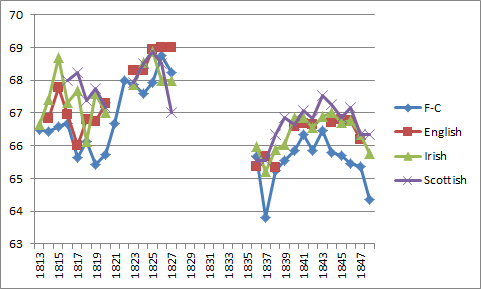
Heights of French-Canadians, 1813 to 1848

Alongside Vadim Kufenko (partner in all crimes) and Alex Arsenault Morin, we have organized the prison records of Quebec City between 1813 and 1848 to measure the heights of the prisonners. Our aim is to study the presence of differences in biological living standards across ethnic lines over time in Quebec and use this measure as an crude indicator of inequality and overall living standards. The paper is at present a short note (a few thousand words) which we have submitted to different conferences (Economic History Society and Economic and Business History Society). We will lengthen the note to a paper once comments have been provided.

In the meantime, here are the preliminary results illustrated and the abstract of our submission to EHS and EBHS conferences is here.

The figure shows the heights in inches by year of imprisonment of males above 20 years of age according to ethnic origin.

HeightsCanadaRAW

New Paper: Celebrating the Simon-Ehrlich Bet and a review of Sabin’s The Bet

My most recent paper, co-written with Pierre Desrochers, we have submitted it to International Journal of Environment and Sustainable Development.  

It can be read in its entirety HERE

Snatching the Wrong Conclusions from the Jaws of Defeat: A Resourceship Perspective on Paul Sabin’s The Bet: Paul Ehrlich, Julian Simon, and Our Gamble over Earth’s Future. (New Haven: Yale University Press, 2013)

Abstract

Historian Paul Sabin’s The Bet aims to present the first full-fledged account of the 1980 wager on the future prices of five metals between ecologist Paul Ehrlich and economist Julian Simon. The Malthusian Ehrlich predicted that growing populations would rapidly deplete the world’s finite supply of valuable resources, causing their price to rise. Simon countered that, in a market economy, prices and technological change would result in resources being used more efficiently, new deposits discovered and substitutes developed, resulting in both less scarce resources and lower prices. Unfortunately, Sabin’s account is marred by a lack of historical perspective, an oversimplification of Simon’s theoretical framework, and a quest to find a middle ground between mutually exclusive positions. This review essay addresses these and other problems.

Seigneurial tenure and development in French Colonial America, 1688 to 1760

UPDATE 15/10/15: Here is the link to the paper on ACADEMIA

As I finish my preparations for the job market, I have also finished formatting a first draft of a paper on the role of seigneurial tenure for Canada’s early economic development. I have sent it to some colleagues for comments. I will soon upload the paper on Academia (I will update this post when it is ready). In the meanwhile, you can send me an email at v.geloso@lse.ac.uk to ask me a copy.

Below is the abstract and the introduction

Abstract: This paper argues that the important transfers from peasants to landlords through private taxes and duties under seigneurial law in the French colonies in North America in the 18th century have been underestimated. They represented a labor income tax which ranged between 4.75% and 6.61% which is a conservative estimate. This high burden of taxation – which was not used to produce public goods – created a supply-side impediment for economic growth.

When Canada was first settled in the 17th century, it was settled by the French who opted to locate themselves in the St-Lawrence Valley (modern day Quebec). Generally, the historiography of that colony points to poor economic performance. Until recently, estimates of that poor performance did not exist. Most of the discussion was qualitative and numerous scholars dissented from that viewpoint.  However, new empirical evidence has solved this problem by providing a long series of wages and prices to compare living standards over time and across regions.The inhabitants of the colony were generally poorer than British settlers in the United States by a substantial margin while they were roughly as rich as the inhabitants of France.

This data points to a certain role to be given to seigneurial tenure – the system of land tenure – as a factor in retarded economic development were correct. In this paper, it is argued that it was an extractive institution which acted like a predatory state. Using the aforementioned data, we can create a measure of the economic burden imposed upon the economy by this system of law and then discuss the type and the quantity of public goods it produced. It is argued that this system of law which allowed landlords to exact fees and dues from peasant households led to an important tax on labor that would have represented between 4.75% and 6.61% of the typical household labor income. The tax revenues generated were not used to finance the production of public goods. The predatory nature of seigneurial tenure contributes to explaining the slow growth and the low levels of living standards in the French colony relative to the American colonies.

Strasbourg wages, 1675 to 1760

In the course of my doctoral thesis, I have collected data of relevance to compare living standards across the Americas by including Canada before 1760. Since it was colonized mostly by French settlers until the King of France ceded it to the British, Canada had to be compare with France as well.

In the process of preparing the comparisons, I opted to use the prices and wages available for Paris and Strasbourg amassed by Robert Allen. However, in the process, I have noticed that these wages are too low. This is a result of the nature of the wages used.

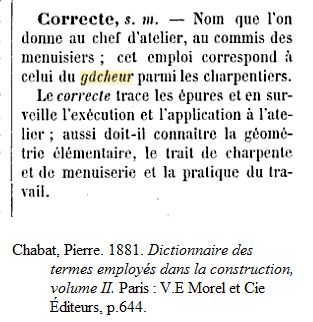
In essence, the problem has been a misunderstanding of the french term used to designate unskilled workers. The term gâcheur does not refer to unskilled construction workers, but rather to workers who were carpenters and highly skilled. They also probably earned wages in kind which were not accounted for in the original data. I have attached to this post the images of the dictionaries where this is properly specified. For a longer discussion of this problem, more information can be found here in my working paper here.

AllenStrasbourg1

AllenStrasbourg2