Childcare services in Quebec: spending explosion

How expensive is a place in one of the subsidized childcare centres of Quebec?  The answer is : quite a lot. Ever since the inception of the program in 1997, spending as exploded while the number of available places have not (sources are the ministry of finances, the ministry of family and childcare and the Treasury Board).  Somehow, somewhere, there must be some overhead costs! This is quite indicative especially if we take into consideration that Pierre Lefebvre of the Université du Québec à Montréal compared the existing tax credit for childcare to the subsidized childcare services. Who benefits? The richest and the poorest only, everyone stuck in-between are worse-off with this policy. Everyone between 26,000$ and 75,000$ are considerably worse off.

In 2010, I took data from the Statistiques Fiscales des Particuliers for the year 2007 (latest available at that time) and checked how many people by income category had claimed the federal transfer for children aged between 2 and 6 and I replicated the tax credit that Lefebvre compares with in order to mimic a monthly transfer modulated to income. The transfer would represent 75% of the cost of childcare for the lowest level of income and would progressively drop to 26 % after 85,000$ and remain there. Such an estimation cannot be a “ballpark” one, but it does yield a saving of over 581 millions dollars for 2010.

Such a policy would contain out of control costs in the system while also allowing supply to match demand more easily. Moreover, poorer households would be directly targeted by the transfer rather than being declined the service or being stuck on waiting lists.

Climate change is (mostly) a development problem

Tonight, I will be making my weekly radio column on CHOI Radio X on the issue of Canada withdrawing from the Kyoto protocol and how that might not be such a terrible outcome. I know this may sound outrageous, but there are costs and benefits to mitigating climate change and we should only mitigate to the extent that it yields net positive results. As for the rest, adaptation might be a better policy.

First of all, I must confess that even though some of you may have pegged me as a conservative and that by extension I must be a climate change “denier”, I do believe that climate change is real and that a large part of it must be caused by human action. However, to say that climate change is caused by humanity does not logically imply a blank cheque for environmental policy.

In fact, I am more optimistic in general than many pundits and academics and a thorough reading of history can only give us an amazing appreciation of how ressourceful humanity is when it needs to adapt.  The dykes in the Netherlands (built well during the late Medieval age) or along the Thames in London are testimony of how humanity can adapt and shield themselves to variations in the natural environment. But adaptation is dependent on the amount of ressources that you might spend at low cost to protect yourself. Hence, the richer a society is, the easier the burden of adaptation is (especially if you account for discounting).

This is why the problems of climate change are mostly by-products of underdevelopment (yes I used that dirty word, no need for political correctness). For example, in a review of the academic litterature on climate change in the Journal of Economic Perspectives, Richard Tol looks which regions of our planet are the hardest hit. Unsurprisingly, the most industrialized and richest societies suffer very little, Eastern Europe and Russia are often net benefactors and those who bear the brunt of the pain are countries in Africa for whom climate change would be disastrous. Just look at the table reproduced from Tol’s work to see it.


Problems of water scarcity, increased malaria prevalance, reduced growth, increased poverty and mass migration (climate refugees) can all be settled by economic growth and wealth accumulation. As these countries grow richer, it will be easier for them to fight malaria with good hospitalization and proper healthcare systems, it will be easier to battle water scarcity if corporations can use capital markets to invest in water recuperation technologies and water conservation techniques for their own profits. It will also be easier to spend ressources on creating the necessary infrastructures to mitigate the effects of extreme weather events (hurricanes, floods etc.).

Hence, maybe spending less ressources on mitigating climate change might not be that farcical of a policy decision especially when there are tradeoffs to be made in order to get the best outcome with the least inputs.

On drugs decriminalization and safe injection sites

A few weeks ago, the Supreme Court of Canada validated the existence of safe injection sites for drugs after years of stalling from the federal government. It didn’t take much time for the Quebec minister of Health to jump on the bandwagon and announce that he would be favorable to using public funds to allow these safe injection sites.

I have to admit that I am skeptical, quite skeptical in fact, of such a decision. I have already argued the case here in a french article to the Prince Arthur Herald. Why am I skeptical? Well, here are the facts about safe injection sites

  • They do reduce the frequency of death by overdose, however the number of lives saved barely inches about 1 life per year according to different reports (one by the EMCDDA in Europe and one by Health Canada);
  • They do reduce the absolute number of notifications of AIDS and HIV, yet could a larger reduction be obtained by other means; and
  • They do allow intervention in order to get addicts off drugs;
But all these results are minimal relative to the operating costs. This leads me to the question that policy makers ought to ask themselves, why not just decriminalize. To decriminalize drugs would mean to transfer the possession and consumption of drugs for personal uses from the realm of criminal accusations to that of administrative sanctions. In short, you would pay a fine like you would for a parking violation rather than going to prison.

Portugal has gone in that direction in 2001 and even though it has hard to obtain statistics pre-2001, the evidence available suggests that in Portugal;

So, there seems to be a cheap policy alternative if one wishes to reduce the adverse effects of drug consumption and that policy is decriminalization. In fact, it liberates resources by reducing the crowding in the justice system and reduces workload for police forces. Now, a simple analysis of risk management indicates that the costs of saving a live (through reducing overdoses and HIV/AIDS) under the policy of subsidizing safe injection sites might be larger than those of saving a life under decriminalization. In fact, the benefits of decriminalization may also outweigh those of subsidizing safe injection sites. Considering the limited resources of Quebec’s government which already taxes above Canadian average and has a considerable problem with regards to spending controls, such an allocation of government funds would be inefficient.

If the provincial government really wishes to reduce the frequency of drug abuses and the accompanying health hazards, the best policy would be to start lobbying the federal government to abandon its war on drugs and move towards decriminalization.

Social mobility and the London Riots

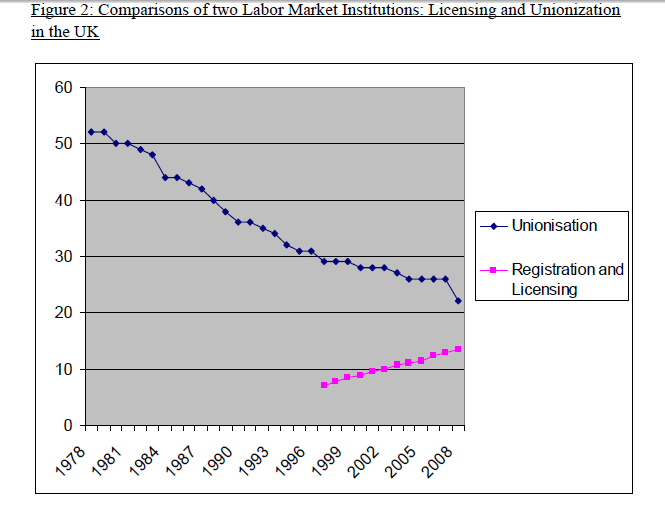
I have recently contended in an article (here) that the London Riots of the summer of 2011 were the cause of a perceived lack of opportunities for upward mobility. I contended that policies that raise the cost of living (zoning laws, import duties, regulations on businesses) are combined with policies that reduce the possibilities of employment as well as the rewards of employment. I put considerable emphasis on the perverse effects of occupational licensing and its rise in the United Kingdom.

There is considerably litterature on the issue of occupational licensing in the United States (where nearly 30 % of occupations are subject to licensing) and the possible effects it has on low skill labour (mostly uneducated natives and African-Americans). There is less data available on the case of the United Kingdom, but the little data we do have does point to a steady rise in the number of jobs being more tightly regulated through licensing (see graph below derived from this paper)