Why should we not care about Debt/GDP ratios?

Such a title might scare some of my fiscally hawkish readers who have – rightfully – identified me as a fiscal hawk. However, I really do believe that the information conveyed by debt/GDP ratios is only “trivial”. The information that holds more value to my eyes is government revenues as a share of GDP and debt as a share of government revenues.

These two pieces of information convey the most importants regarding solvency. If a country has a debt that is equals to 100% of its GDP, but whose government revenues are only 10% of the economy, then things are not as bad as they look. It means that this country might be able to tax more without hampering economic growth. However, if another government has a debt standing also at 100% of GDP but whose revenues already represent 50% of GDP, there is considerably less room for collecting ressources to pay the debt without hampering economic growth (hence obtaining less revenues than projected). I have written on this issue in the past (with Quebec in mind) and I believe it might be time to refocus the technical debate on these pieces of information rather than only Debt/GDP ratio.
New Working Paper : A match made in heaven – free markets and morality

I have extended my winning essay from the Institute for Liberal Studies into a longer paper which I do not know what to do with for the instant. However, I believe it might be interesting for anyone to read an extended version of the arguments I made during that contest.

So here the link and you can find it in the publications section

Forget bilateral liberalization, forget even multilateral, go for unilateral!

Have you heard of the Doha round of trade liberalization in recent times? To be very honest, I have not either and its no surprise since it is dead. So if this round of trade liberalization negociations is dead, how do we pursue the reductions in trading barriers? The alternative often presented are Preferential Trade Agreements (PTAs). Under PTAs, two countries will negociate a free trade deal between the two of them (maybe more). They will reduce non-tariffs barriers and tariffs barriers for goods they produce. However, this is not free trade, it is managed trade.

Changing the value of trade barriers between two countries might just change relative prices. If the United States dropped their tariff on tires coming from China, but not India (who might be a more efficient producer of tires than China), production in China will increase but it will not increase overall and prices for imported tires may not decline as much as they could. This is why PTAs are not free trade, they are managed trade and they distort international trade. Moreover, such agreements are also subjected to “regulatory capture” with interest groups (lets say tires producers in China competing with Indian producers) convincing governments to pursue such a policy. Hence PTAs are mostly beneficial to certain industries in the participating countries and not as much as they could for consumers (and some argue detrimental).

Multilateral negociations can also block quite easily as we have seen with the Doha round of negociations, so how can we pursue trade liberalization? I think this 1998 paper by Sebastian Edwards might be quite insightful because it concerns the strategy of unilateral trade liberalization that Chile followed. The country chose to create a uniform tariff that would be applied on every good and services imported rather than negociating reductions for X and Y goods. Razeen Sally in an ECIPE paper also underlines quite intelligently how several developping countries (in East Asia) have opted to liberalize – unilaterally.  Of course I am biased in favour of such a policy since in the past, I have written in favour of using this approach in Canada (especially with regards to agricultural supply management schemes).


The Eastern Front: Casualties

In June 2009, I took a class at Montreal University titled Canadian Military History which brought me to France (as a part of the class) to visit battlefields where Canadian forces engaged either forces of the Hohenzollern monarchy during the Great War or of the Third Reich during the Second World War. During my visit of La Somme, one of the bloodiest battle of the Great War, we could walk in the fields and still find bullets, weapons, shells, helmets, belts and all sorts of military remnants (picture here of me with a cannon shell of unknown origin). This gives you an image of how extensive the destruction was. Well, imagine that rather than finding fields of spent ammunitions and supplies, we had instead found fields of human bones…

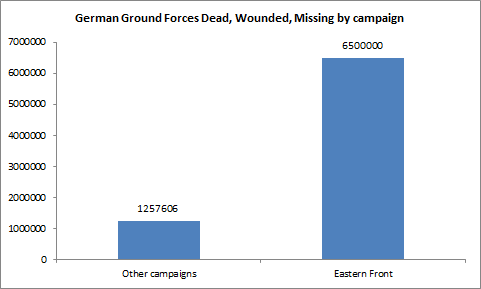
Then you can imagine how peasants in the Western part of Russia feel when they find human bones in what are now called “bonefields“. Posting data here on this blog on military history (amongst other things) is not sufficient to convey how terrible some realities are. In fact, it took only one single battle – the battle of Kursk in 1943 – for German casualties(201 000 according to Michael Carver’s The Warlords) to exceed those suffered in the campaign to conquer France and the Africa Campaign (154,740 and 102,000 according to McNab). After detailing this, you can now see this graph which illustrates the extent of German Losses (and Soviet losses) on the Eastern Front. You think this is terrible? Consider that at the same battle of Kursk, the Russians lost over 800,000 soldiers against the German. Overall, 27 millions Russians lost their lives during World War II according to Constatine Pleshakov’s Stalin’s Folly and the some 900,000 of those in the first twenty days of the German offensive…

Add-on (July 28th 7h45 PM) – My friend P-A Beaulieu sent me this link with illustrations of findings on the Eastern front (weapons, bones, various accessories of both German and Soviet origin)