If you speak French and are interested in listening to a discussion on Quebec City’s CHOI Radio X on the topic of gasoline prices, you might want to follow this link. Please note that they have labelled me as a Ph.D student in Economics, which is not the case, I am a Ph.D student in Economic History. It is closely related, but it is not exactly the same.
Author: Vincent Geloso
Cornucopian economist, statistics freak and quantitative historian trained at the London School of Economics. I specialize in economic demography, law and economics and economic history (especially the measurement of living standards).
Did you know? (2)
Did you know that in the province of Quebec, there were 413 municipalities in 1915 that had statutes prohibiting the consumption of any alcohol? In comparison, there were 440 municipalities without any restrictions and 45 with partial restrictions. Moreover, only 72 alcohol bottlers were licenced to operate in 1915, a number which stood at 71 five years earlier.
Source: Annuaire Statistique du Québec, 1915, p.412
ICA Tresholds for review
Under the Investment Canada Act (ICA), the federal government has the right to review mergers and acquisitions and evaluate if they create a “net benefit” to Canada. From its implementation in 1985 to 2008, reviews rarely blocked transactions (if ever, I have not found any in literature reviews). However, starting in 2008, the threat of using the ICA to block investments has been raised (LSE-TSX merger) quite often and two transactions (Alliant/MacDonald-Dettwiler and PotashCorp/BHP Biliton) were blocked outright. For the benefits of my readers, I am publishing the inflation-adjusted thresholds for review (above that amount, the federal government has the right to review).

An exercice in price trends
I have recently found data in Quebec Statistical Yearbook for 1914 that placed the price of a gallon of gasoline at 25 cents in Montreal (or 6.65 cents a liter). According to Kent Marketing’s database on retail gasoline prices without taxes, in 2010, the average price of a liter of gasoline in Montreal stood at 67.1 cents.
Correcting for inflation (2002$) , this means that in 1914, a liter of gasoline cost 110.87 cents compared to 58.04 cents. Many individuals have documented this downward trend of real gasoline prices. However, few have looked at the price of gasoline relative to wages.
According to the Institut de la Statistique du Québec, a machinist had an average real income of 47,659 $ in 2010. According to the manufacturing census of 1910 (available in the Quebec Statistical yearbook of 1914), the average machinist had a real annual income in Montreal of 6,650 $.
If we make the hypothesis that in both the worker of 1914 and 2010 had an average week of forty hours and worked 49 week per years, we can see how time of work was needed to buy a liter of gasoline.
In 1914, you had to work 19.6 minutes to acquire a single liter of gasoline. In 2010, you only had to work 1.4 minutes. This means that relative to wage, the real price of gasoline dropped 92 % since 1914. Of course, this percentage might in fact be higher considering that the workweek was longer in 1914 than in 2010.
I am currently trying to assemble a time series that will try to illustrate this long term trend for many products. So, if you ever do find books, magazines or old “Sears Catalogue”, please communicate with me at vincentgeloso@hotmail.com and share it with me (at a price if necessary).
New Data Set : Fees for Cosmetic Surgeries
In yesterday’s post on fees for corrective eye surgery for Lasik (US) , I asserted that there were virtues to entrepreneurship in healthcare. Such entrepreneurship was – in my opinion – allowing either for a control of costs or even a slight reduction in prices. Since we have all been used to see the price of medical services increase in inflation-adjusted dollars, seeing a medical service whose price is dropping took some of my readers by surprise.
Since corrective eye surgery is one of the few lightly regulated medical act in the United States, there is room for medical entrepreneurs to improve the quality of their service (which is not reflected in my own data) and reduce prices in that particular sector. However, there is another medical area with little government regulation in the United States of either prices or practices : cosmetic surgery.
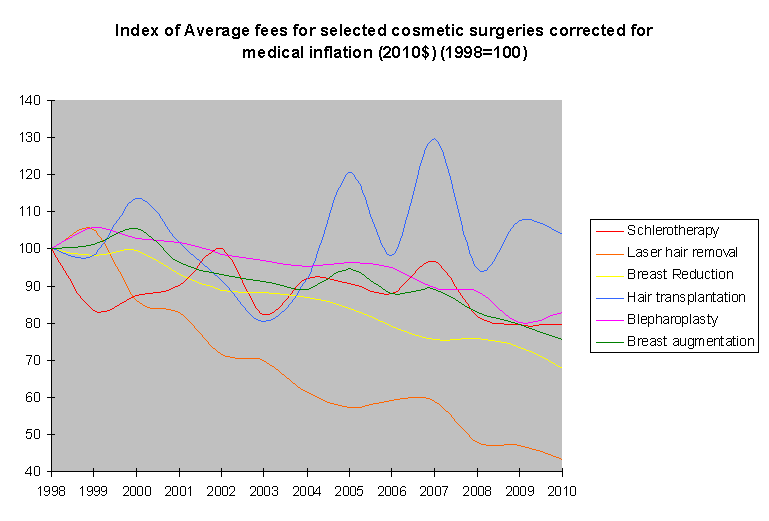
Widely perceived in television series like CSI or NipTuck as something for “rich” folk, cosmetic surgeries are nonetheless on the rise in the United States. Between 1997 and 2010, there has been a 155% increase in the number of cosmetic procedures. Yet, we can also observe a trend similar to corrective eye surgery (except hair transplantation) with regards to prices : they are either falling or staying stable (accounting for either medical inflation or all-items inflation). This new data set is available in my data set section and the graphic are illustrated below.
We must be left to wonder if this is caused by entrepreneurship and competition (as in all other sectors of the economy) or by something else?

 Vincent Geloso