Calorie Intake in Germany during World War II

Continuing with data series regarding World War II, I have found this data set (still in McNab’s fascinating book) concerning the daily intake of food derived from the ration tickets emitted. Even if I reproduce this data here, I might venture a word of warning regarding the “food intake” in this case. It concerns only “german” civilian and not the vast population of slave labourers forced to toil under the yoke of the Nazis. Let us remember that in January 1945, there were 6,691,200 individuals working in Germany as slaves (including prisoners of wars and political prisonners). This included all the “races” which the Nazis considered as inferior (Balts, Russians, Yugoslaves, Jews, Gypsies, Czechoslovaks, Ukrainians and Poles) who died in greater numbers than their French, Belgians, Dutch, English or Italians counterparts due to intentional malnourishment by the Nazis.  It seems reasonable to assert that the real food intake for all individuals within the Third Reich during World War II was considerably lower than those reported in the data below.

Note also that McNab mentions that the prewar calorie intake was close to 3,000 kcals per day.

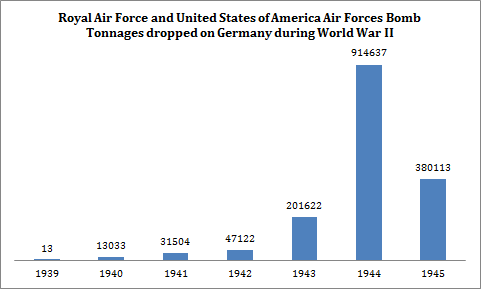
Bombs dropped on Germany during World War II

In my quest to continue to provide data to military historian in ways that are easily accessible to them, I am publishing a new data set regarding World War II. In Chris McNab’s 2009 book on the Third Reich, there are so many data series available that I feel compelled to share them, starting by this figure about the tonnage of bombs dropped on Germany by the Royal Air Force and the United States of America’s Air Force.


Did you know? (2)

Did you know that in the province of Quebec, there were 413 municipalities in 1915 that had statutes prohibiting the consumption of any alcohol? In comparison, there were 440 municipalities without any restrictions and 45 with partial restrictions. Moreover, only 72 alcohol bottlers were licenced to operate in 1915, a number which stood at 71 five years earlier.

Source: Annuaire Statistique du Québec, 1915, p.412

ICA Tresholds for review

Under the Investment Canada Act (ICA), the federal government has the right to review mergers and acquisitions and evaluate if they create a “net benefit” to Canada. From its implementation in 1985 to 2008, reviews rarely blocked transactions (if ever, I have not found any in literature reviews). However, starting in 2008, the threat of using the ICA to block investments has been raised (LSE-TSX merger) quite often and two transactions (Alliant/MacDonald-Dettwiler and PotashCorp/BHP Biliton) were blocked outright. For the benefits of my readers, I am publishing the inflation-adjusted thresholds for review (above that amount, the federal government has the right to review).