Could seigneurial tenure have mattered?

This paper is intended as a conference paper. It encompasses an earlier article we have already submitted (on living standards in Lower Canada in 1831). However, it considers the question we (myself and my co-authors) thought the most relevant: did seigneurial tenure in Canada have an important impact?

The peculiarities of seigneurial tenure as a land tenure system were unique to Canada and, we argue, create barriers to economic activity. While we are not the first to consider this channel to explain Canada’s poorer economic performance (more precisely, the French part of Canada), we are the first to ask the question if it did matter using empirical estimates. Numerous scholars have claimed that while it may not have helped, the impact of seigneurial would have been – at best – limited. Using wages and prices from across the colony in the census year of 1831, we can isolate the effects of institutional differences on real wages. When we control for environmental factors and access to markets, we find that non-seigneurial areas enjoyed a wage advantage over seigneurial areas ranging between 29% to 39%. We argue that, while the channels through which those differences would have emerged are manifold and thus would require individual studies, it is clear that seigneurial tenure did matter.

The paper will be presented at the Economic and Business History Society meeting in Montreal (may 2016). The paper is available here. 
Joining Texas Tech University

In a few months, my PhD at the London School of Economics will be completed (waiting for exam date to be settled). Thereafter, I will be joining Texas Tech University (TTU) for a limited-term appointment as post-doctoral researcher associated with the Free Market Institute (FMI website here)

The FMI has numerous scholars interested in public choice theory and the teachings of economists like James Buchanan, Elinor Ostrom, Gordon Tullock and F.A Hayek. I intend to use my time at TTU and the FMI to perfect these aspects of my research. On top of continuing my empirical papers on measuring living standards, I also intend to expand on some ideas I have been entertaining regarding population and institutions (see notably my infant mortality paper with Arsenault Morin and Kufenko and my malthusian pressures paper with Kufenko).

Measuring Away the Importance of Institutions: The Case of Seigneurial Tenure and Agricultural Output in Canada East, 1851

My most recent paper, which I have submitted, argues that there are problems in the way we have been using the 1851 census of Canada East. The issues relates to properly measuring volumes of grains grown and land area for farming. I argue that, since the difference in measurement units follow ethnic lines, the errors of measurements disadvantage areas that were not operating under seigneurial tenure. Thus, my assertion is that we have been using the census of 1851 to “measure away” the role that institutions might have played in economic divergence. Indeed, non-seigneurial areas exhibit higher levels of output and productivity per unit of land than when more conventional approaches to the census are used.

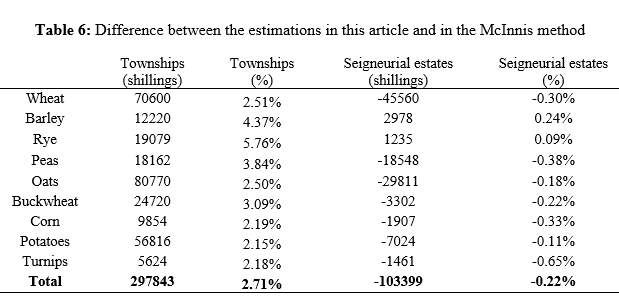
Here is a key passage of my paper which can be downloaded here on Academia (see table below for output measurements):

Overall, the total value of production in townships is 2.71% greater if we correct for volume measurements, and 0.22% smaller in seigneurial domains in total. The results can be seen in table 6. This may appear small, but given that McInnis and Lewis (1980) found that the productivity gap between French and English farms was somewhere between 8% and 14%, that difference is increased substantially. Another way to state the significance of these differences is that, on a per acre basis, output expands by 7.49% in townships and deflates by 1.39% in seigneurial areas. More significant is the distribution of these measurement errors. This new approach to correction implies larger errors in ethnically mixed areas – which, once again, tended to be townships.

DataOutput

Interview on deficits, public choice and immigration

Normally, I do not share the interviews I make with the media on this website since they tend to “public policy” interviews and this website is dedicated to my research and my research-oriented comments.

However, I am making an exception because I gave a long interview to Point d’Équilibre (in french) where me and the interviewer (Zechiel Houle-Breton) discuss the empirical and theoretical literature on deficits, public choice theory and immigration. The interview (again, it is in french) can be found below.


Inequality, Capital and Many Other Things in the 21st Century (and Before)

I have a new article, this time in Essays in Economic and Business History. It is an invited review of the upcoming book of Peter Lindert and Jeffrey Williamson (Unequal Gains at Princeton University Press). It underlines the limitations, strengths and the potential of the book while also proposing modifications to the policy proposals.

The article is available here (on Academia) and here (on the EBHS website)