The case for privatizing the Port Authority of Montreal

A few days ago, La Presse revealed that the corruption allegations at the Port Authority of Montreal would be dropped. Obviously, members of the opposition criticized the “political back-scratching” that might have occured between the Office of the Prime Minister (via Dimitri Soudas) and some dubious businessmen. Anyways, politics aside, if one really wishes to avoid corruption in the future why not look at the option of privatizing the Port Authority?

The privatization of Port Authorities is – contrary to one might believe – a policy which has yielded very positive results. As a World Bank paper noted back in the late nineties, privatization and liberalization of Port authorities in Colombia

(…)resulted in large and rapid improvements in productivity, lower fees for port users, and very attractive returns for the concessionaires. Productivity levels are higher than in most newly privatized ports in other Latin American countries—where in many cases the ports have been privatized with limited competition. The improvements have been realized with low initial investments, though recently the port societies have gone beyond investing in shoreside equipment and are starting to invest in infrastructure expansion.

The privatization of the Port of Bristol in the United Kingdom by the Thatcher government transformed the port from a loss-making venture to a profitable one in the early one in the early nineties. Hence, taxpayers were not responsible of paying the losses via subsidies. Moreover, this amazing turnaround occured in spite of a relative decline of the importance of Bristol to other British ports.

Maybe its time to look into such a policy course for Montreal, if its private hands, there is little place for political jockeying for positions…


Supply Management: the grinch who ruined xmas?

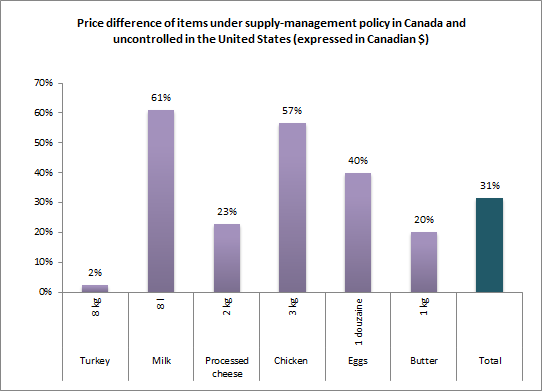
Last year for the Christmas edition of my weekly radio column at CHOI, I calculated the cost of supply management in Canada. This policy is basically one where the government gives production quotas (which can be traded, but whose number is fixed by decree) to farmers of poultry and dairy products. The intent of that policy is to reduce supply in order to increase prices for farmers. Who pays? Consumers (who have no choice because there are import tariffs of up to 298% on certain goods under supply management)!

So I decided to compare the prices in the United States and transposed them in Canada for the same item. Last year, some claimed that my results were produced by the fact that the exchange rate was favorable to my case (44% more expensive in Canada). However, this year, the exchange rate for the period selected is on near parity (1.01$ to the CAD). The gap for all items has indeed dropped, but most of that gap is caused by the change of the exchange. The remaining gap still accounts for 31% of the difference! This is a huge difference which could amount to hundreds of dollars in extra costs to families.

Considering that the demand for food items is quite inelastic, those who are ill-suited to afford these higher prices are the poorest in Canada! When you’ll be leaving milk for Santa Claus this Christmas, remember that supply management is the Grinch that makes the holidays harder to enjoy for many of us!

Austerity is cool, pre-austerity is cooler!

As everyone debates Italy’s recent bold steps to increase competitiveness (which is a problem in Italy as total factor productivity has in fact being declining – not slowing down – but actually declining since 2006) and cut spending, one ought to remember that austerity measures are a good signal to send to financial markets and investors (its also good for tax smoothing in the longer run). Yet, no one notes that the countries which have applied “pre-austerity” measures actually performed correctly and have been spared the worst of the crisis.

Take Germany, according to a recent IMF publication (Chipping Away at Public Debt by Paulo Mauro), if Germany had preserved its previous policies with regards to competitiveness and spending, it would likely be in a situation as uncomfortable as France or even Italy.  Between the 2001 recession and 2003, the German economy was in a virtual standstill, yet public spending was evolving at a faster pace than revenues, hence worsening the deficit. Interestingly, one should note that the overall balance of the total budgets in Germany as a share of GDP has actually been negative since the early 1970s. So, in 2003, a serious attempt was made in Germany to bring about “fiscal consolidation”. What were the serious reforms?

  1. Corporate tax cuts
  2. Reform of employment insurance (benefits were reduced, shortening duration and admission was made harder)
  3. Pension reform (annual increases in benefits would be reduced if the relative number of pensioners to workers increased)
  4. Reduction in agricultural, construction and coal mining subsidies

Overall, these reforms were modest, but they did enough for Germany to be in the best shape to face the euro crisis and the straight jacket of the euro (where currency devaluation is not an option). But, did Germany balance its budget? Not even, it merely reduced the size of its deficit from around 2.5% of GDP to 1% of GDP. I am not saying that Germany didn’t do good, but even timid steps in good years are wise especially since they allow to smooth tax rates so as to minimize distortions and welfare losses. However, it does seem that politics is not about good economics…

Gasoline price control in Quebec

Since 1998, Quebec has confirmed its status of “distinct society” in the realm of policy. As all the other provinces debated price ceilings on gasoline (some have in fact adopted such price controls), Quebec opted for a price floor on gasoline. When that measure was adopted, Quebec had just experienced a decade long price-war in which the real price of gasoline at the pump dropped 36% (from January 1987 to to December 1997). At that time, it was feared that integrated oil refiners and retailers were attempting to exclude independent retailers from the markets by lowering prices below their cost so as to drive the latter out of the market. Hence, a price floor was adopted. The price is modulated on a weekly basis and policy markets decide of the price upon how the price of a barrel of oil evolves.

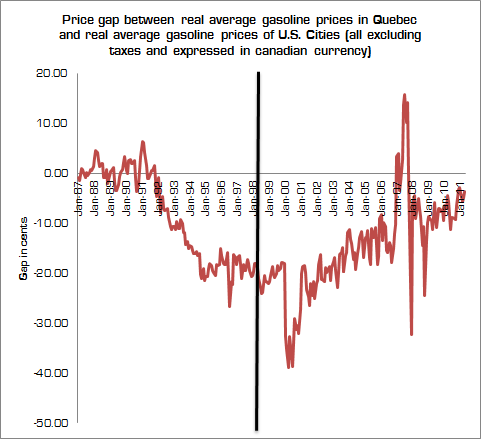
So what has happened since then? Well, I took the time of composing a data set of average real retail prices of gasoline in U.S. and Canadian cities (from Kent Marketing and from the Energy Information Agency). I managed to compose an average retail price price of gasoline in Quebec on a monthly basis from January 1987 to April 2011. Then I analyzed the gap between Quebec and the average of U.S. cities in order to see how Quebec evolved relative to the United States before the adoption of the price floor and after the adoption.

As you can see, before 1996 prices drop considerably relative (the bottom half of the gap signifies that prices are lower in Quebec than in the U.S. average) to the United States, then they stabilize for three years only to keep on increasing relative to the United States from the 2001 recession up to now. The black line represents the date at which the floor price came into effect. Is there a relation between the presence of a control price and the decline in the relative position of Quebec? This is something worth testing and could shed light on how costly (through the prevention of price wars) this policy has been to drivers in Quebec? 

Electricity in Quebec before nationalization

Most of my friends know that I am a proponent of privatizing Hydro-Quebec, the crown corporation in charge of electricity production and distribution in Quebec, and of liberalizing the energy market. When I make my case, many will argue that when we had a free markets (in the 1920s), corporations were gouging consumers since they had monopoly power. As a matter of fact, they do have some empirical evidence of higher prices in Quebec than in neighbouring Ontario.

However, that is a clear case of cherry-picking. Why? Because starting in 1903, the government of Ontario intervened in the energy market by buying electricity from private firm and selling it at cost to consumers in the municipalities who decided to participate in the scheme. The government covered the difference. Comparing a subsidized system with an unsubsidized one is clearly some cherry picking. Moreover, in the early 1920s, Ontario actually went a step further and nationalized its electricity grid (well, a part of it).

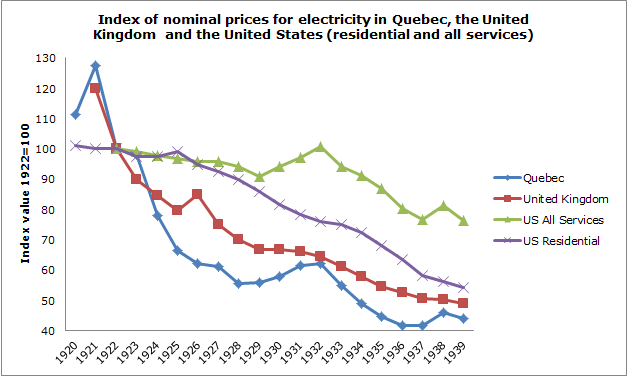
Meanwhile in Quebec, non-intervention was the rule up to 1935 and nationalization only occured in 1944. So how did Quebec compare with other places where the real cost of electricity wasn’t being passed on to taxpayers? Well, here is an index of different measures of electricity prices in the United States, the United Kingdom and Quebec. What I see is a clear decline in nominal prices, a decline which is in fact steeper than elsewhere!

Sources are from Statistical Archives of the Quebec and Canada Year Books, from the Historical Statistics of the United States and from Leslie Hannah’s Electricity before Nationalization: A study of the development of the electricity supply industry in Britain to 1948. As these data are being assembled for a research paper, they will not be published on this website until the peer-review process has been completed. But I do believe that this graph tells quite a story!