An exercice in price trends

I have recently found data in Quebec Statistical Yearbook for 1914 that placed the price of a gallon of gasoline at 25 cents in Montreal (or 6.65 cents a liter). According to Kent Marketing’s database on retail gasoline prices without taxes, in 2010, the average price of a liter of gasoline in Montreal stood at 67.1 cents.

Correcting for inflation (2002$) , this means that in 1914, a liter of gasoline cost 110.87 cents compared to 58.04 cents. Many individuals have documented this downward trend of real gasoline prices. However, few have looked at the price of gasoline relative to wages.

According to the Institut de la Statistique du Québec, a machinist had an average real income of 47,659 $ in 2010. According to the manufacturing census of 1910 (available in the Quebec Statistical yearbook of 1914), the average machinist had a real annual income in Montreal of 6,650 $.

If we make the hypothesis that in both the worker of 1914 and 2010 had an average week of forty hours and worked 49 week per years, we can see how time of work was needed to buy a liter of gasoline.

In 1914, you had to work 19.6 minutes to acquire a single liter of gasoline. In 2010, you only had to work 1.4 minutes. This means that relative to wage, the real price of gasoline dropped 92 % since 1914. Of course, this percentage might in fact be higher considering that the workweek was longer in 1914 than in 2010.

I am currently trying to assemble a time series that will try to illustrate this long term trend for many products. So, if you ever do find books, magazines or old “Sears Catalogue”, please communicate with me at vincentgeloso@hotmail.com and share it with me (at a price if necessary).

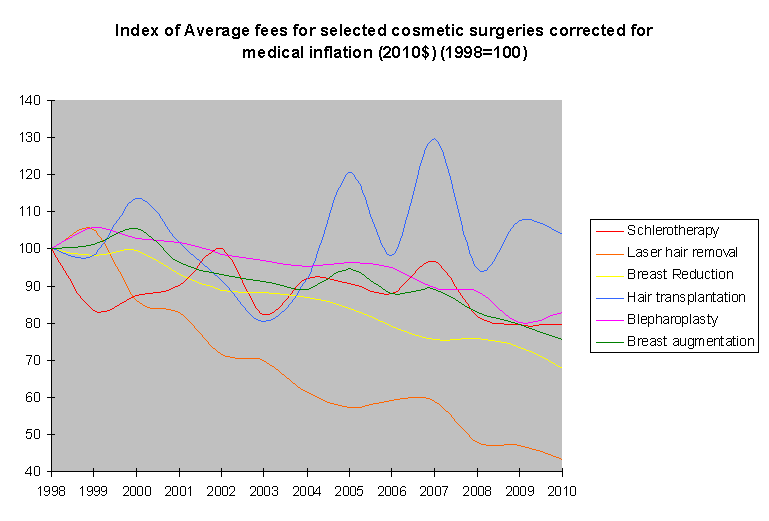
New Data Set : Fees for Cosmetic Surgeries

In yesterday’s post on fees for corrective eye surgery for Lasik (US) , I asserted that there were virtues to entrepreneurship in healthcare. Such entrepreneurship was – in my opinion – allowing either for a control of costs or even a slight reduction in prices. Since we have all been used to see the price of medical services increase in inflation-adjusted dollars, seeing a medical service whose price is dropping took some of my readers by surprise.

Since corrective eye surgery is one of the few lightly regulated medical act in the United States, there is room for medical entrepreneurs to improve the quality of their service (which is not reflected in my own data) and reduce prices in that particular sector. However, there is another medical area with little government regulation in the United States of either prices or practices : cosmetic surgery.

Widely perceived in television series like CSI or NipTuck as something for “rich” folk, cosmetic surgeries are nonetheless on the rise in the United States. Between 1997 and 2010, there has been a 155% increase in the number of cosmetic procedures. Yet, we can also observe a trend similar to corrective eye surgery (except hair transplantation) with regards to prices : they are either falling or staying stable (accounting for either medical inflation or all-items inflation). This new data set is available in my data set section and the graphic are illustrated below.

We must be left to wonder if this is caused by entrepreneurship and competition (as in all other sectors of the economy) or by something else?


LASIK eye surgery

Many individuals claim that a free market in health care leads to increased prices, while others have claimed the reverse.  All of them point to soaring health care costs in the United States.

Eye surgery (corrective sight operations) is  one of the few health-related markets that is unregulated in the United States and there we have seen a different trend than for the overall health care service industry. While the nominal price has increased, the price corrected for both “all items” CPI and “medical” CPI has led to either a stable price or a slight reduction.

In my “data sets” section, you will find a series that pertain to the price of LASIK’s operation per eye. The data is suggestive and not autoritative as I have combined different sources. I am especially cautions about the 1999 data point as it is derived from a research that charges to obtain their study, which makes it impossible to evaluate the reliability of the data.

However, I do believe that this data set can be somewhat useful in illustrating the benefits of markets and competition in the world of health care.

Male Organ Size and GDP per capita

When academics have too much free time on their hands, funny papers like these are to be found:

In particular, it was shown that the relationship between per capita GDP in 1985 and penile length evidenced an inverted U-shaped pattern. A strongly negative association between GDP growth from 1960 to 1985 and male organ was also identified. Somewhat surprisingly, male organ was a stronger determinant of economic development than country’s political regime type at the Polity IV autocracy-democracy spectrum.

Source: Tatu Westling. 2011. Male Organ and Economic Growth: Does Size Matter? Helsinki Center for Economic Research, Working Paper

The income of taxi drivers in 1979 in Montreal

In 1973, when the taxi market was put under a province-wide supply management scheme with permits to operate, it was claimed that this was prompted by the difficulties of taxi drivers to earn a decent living. We can’t know for certain what the average income of taxi drivers was in 1973 before the reform, but we do have data for 1979. In that year, GDP per capita adjusted for inflation was 24,798 $. The net income (income minus operating expenditures) stood at 27,113 $. Considering that since 1979, the rent value of taxi permits has increased through buyback plans and an upward surge of demand (see my paper on taxi in “publications”), it is very likely that this gap still exists between older drivers and the general public. Younger drivers may in fact be harmed by the mortgage that they must pay for acquiring a permit. I think it is possible that the income gap exists between younger drivers and older drivers and between older drivers and the average worker.

Source: Michel Trudel, 1981. Des Nouvelles Avenues pour le Taxi. Ministère des Transports du Québec