Purchasing power in New France and France and minimizing American exceptionalism

In recent times, Jeffrey Williamson and Peter Lindert have been attempting to assert that American living standards were much higher than in Britain in the colonial. An important part of their claim centers on the differential of purchasing power parity. This makes America looks richer on the eve of the American revolution. I don’t dispute that part.

However, I do dispute that it was something exceptional within the thirteen colonies since I think that the colony of New France, a small settlement of roughly 60,000 individuals in 1760, had a similar advantage over its mother country of France and likely over Britain. I can’t be sure about how it stood relative to America (I am still playing with my creation of output and wage estimates), but its level of living standards should not have diverged too much from those observed in America.

Why do I say that? Well here is a table from my thesis which compares prices in France to prices in Quebec (prices in Quebec divided by prices in France). As you can see, prices in French America – except for import prices – are considerably lower than those in France. In my modest opinion, this means that a parrallel can be drawn between Lindert and Williamson’s focus on British/American purchasing power and French/Canadian purchasing power.
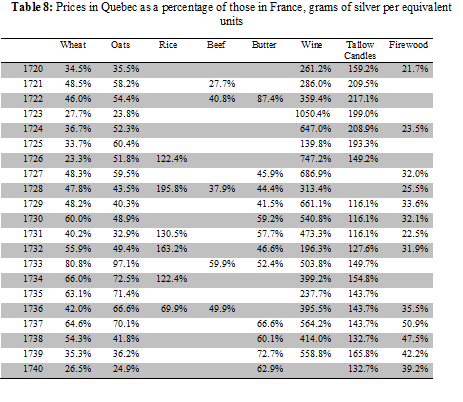
Revisiting WilliamsonSo what about prices in Quebec to those in the Colony? Here, I am more prudent since converting currency units is extremely delicate. However, using the Hoffman rates for the grams of silver per livre permits me to draw the following image of the differences in prices between Quebec and Philadelphia. For flour, wheat and wine, the inhabitants of Quebec had to pay less than the inhabitants of Philadelphia while the latter paid less for rum, beef and salt.

PricesQcPhila

From this, its hard to assert something about the relative purchasing power of the two colonies. However, I think it makes the American colonies seem less exceptional in economic history. This makes me think also that the real question is not whether or not colonial economies overtook “old world” economies, rather the question is why did that one (the US) actually had faster growth for most of the 19th century and Canada’s growth only took up in the late 19th century and early 20th century?

NOTE: This is all still formative thinking. However, the tables presented for prices are pretty solid.
 

Bouffe de rue: voulez-vous une baisse de prix?

On apprenait aujourd’hui dans le Journal de Montréal, que les restaurateurs de rue ne comptent pas baisser leurs prix. Ceci semble indigner certaines personnes, dont le maire Denis Coderre. Il s’agit là d’une drôle d’indignation. Oui, drôle … voir burlesque.

Burlesque parce que la ville de Montréal est responsable des prix élevés en limitant l’offre par sa réglementation. La ville fixe l’attribution des permis à un maximum de 30 permis qui coûtent 1500$. Ces permis sont attribués selon le choix des administrateurs de la ville. 

L’offre étant limitée à 30 permis et la sélection de l’offre dépendant de la volonté des fonctionnaires, il est déjà normal que la demande soit très importante relativement à l’offre et donc que les prix soient élevés. De plus, la ville limite massivement les points de vente (ils sont peu nombreux et répartis sur de grandes distances). Ceci empêche aussi aux consommateurs de mieux comparer les prix et d’exercer une pression sur les commerçants. Finalement, le mécanisme d’attribution est conçu pour conserver le peu de concurrence introduite dans un segment très mince du marché – celui des produits de niche qui coûtent plus chers. Par conséquent, les consommateurs ne peuvent pas faire des jeux sur le rapport qualité/prix (choisir entre un crab-cake super fancy et un hot-dog cheap enrobé de bacon avec de la moutarde et de la relish). Ainsi, aucune concurrence ne peut s’exercer sur le rapport qualité/prix. 

Au final, le mécanisme mis en place par la ville est conçu pour éviter l’exercice de forces qui pourraient réduire les prix. Et ensuite le gouvernement municipal se plaint que les prix augmentent … 

Autocorrelation as a tool for economic historians: New France and Lower Canada

I was working on my thesis and a weird idea struck me. More specifically, I was working on market integration between Quebec City and Montreal from 1688 to 1840. Generally, I used the coefficient of variation (standard deviation of observations over average). However, trends in market integration could be measured by the extent of serial correlation.

Normally, serial correlation (the past values of the dependent variable explain the present values) is a pain in the neck. But serial correlation could also be a sign of a violation of the efficient market hypothesis. The efficient market hypothesis were absent since this hypothesis states (in its strictest form) that all price changes should only come from new information as current prices reflect all the information available. Its like looking forward when you drive. If past values have large predictive power, this means that you drive forward by looking in the rearview mirror only.

However, if the predictive power of past prices evaporates progressively, this means that markets would have been working more efficiently (a necessary condition for market integration). So, does it work?

Between 1760 and 1840, the regression model shows that the log of wheat prices in Quebec follows this function:

Log Qc Price (1760 to 1840) = 0.42 * MtlLogPrice + 0.15 * QcLogPricePreviousYear + 0.38 *MtlLogPricePReviousYear + 0.08

All the variables, except the price of wheat in Quebec the year before, are statistically significant at the 99% level. The R2 is 0.74.  So what about the period of french rule for which I have prices from 1688 to 1760?

Log Qc Price (1688 to 1760) =  0.31 * MtlLogPrice + 0.30* QcLogPricePreviousYear + 0.43*MtlLogPricePReviousYear – 0.03

This time, all the variables are statistically significant at the 99% level and the R2 is higher (0.84). The changes in the predictive power of past values of wheat prices in the Quebec area would indicate that markets for grain grew more efficient in the era of British rule relative to the era of French rule.

Price index, Quebec from 1688 to 1860

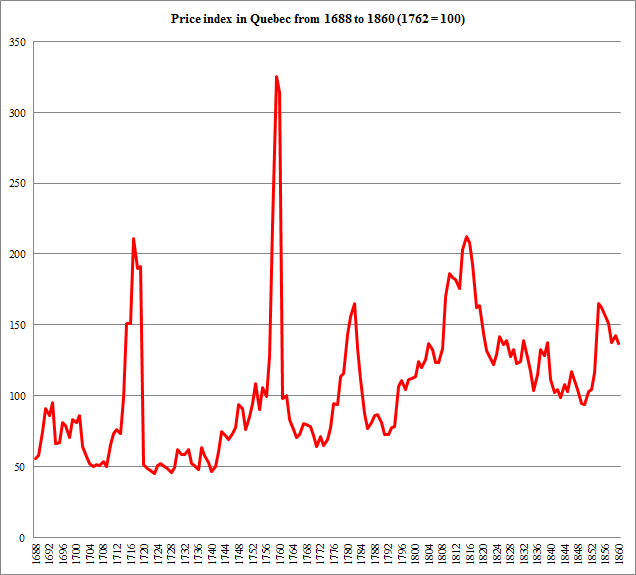
In the course of writing my thesis, I have collected important quantities of price quotations for roughly one hundred and fifty items that were traded in the colony of Quebec from 1688 to 1760 and I am pursuing this up to 1860. However, there was already a price index produced by Gilles Paquet and Jean-Pierre Wallot for the period after 1760 which was not meant as a measure of the cost of living than as a measure of changes in the general price level (I am trying to do the former, which is more complicated). My index for New France is complete up to 1763 and it means that I can link it up with the index produced by Paquet and Wallot to get an idea of the general price movement. What does it look like? Well, here it is.
PriceIndex
This is still preliminary work, but one can see how prices evolved in the colonial economy of Quebec prior to Confederation.

Jean Chrétien en Nouvelle France

Au cours de mes recherches aux Archives du Séminaire de Québec, je découvre souvent des faits inusités sur l’histoire du Québec. J’ai notamment retrouvé un Jean Chrétien qui travaillait aux fermes du Séminaire de Québec en 1736. Il était payé 25 sols pour chaque de travail “aux récoltes” et 25 sols par jour de travail “aux foins”. Son salaire quotidien comme travailleur journalier sans spécialisation était suffisant pour acheter 0.67 minot de blé – soit 64 807 calories.

Considérant environ 200 jours de travail à la ferme (période des semences et de la récolte), il s’agit d’un revenu annuel de 250 livres (il y avait 20 sols par livre).Le panier du travailleur anglais de l’époque (le plus riche de l’Occident à l’époque) coûtait 301 livres au Canadien-Français. Cependant, en essayant de créer un panier de consommation plus proche de celui actuellement consommé par les habitants de la Nouvelle-France, Jean Chrétien aurait du dépensé 241 livres pour obtenir un niveau de vie décent et 181 livres pour se hisser au delà du seuil de pauvreté.

Voilà comment vivait cet individu qui était probablement l’un des ancêtres du Jean Chrétien qui fut premier ministre du Canada.

Source: SME 4, LIVRE C8