Privatization should never be about increasing revenues, but about productivity

The Economist’s most recent edition ponders how privatization of certain crown corporations could be used by governments that are starved for liquidities in the face of large public debts. The claim is that privatization would increase revenues and pay off parts of the public debt. I think that this is the wrong reason to enact a privatization.

The collection of additional revenues to pay off debts is merely a “bonus” of privatization. The point of privatization is to invite market discipline within the company in order to increase productivity as I argued three years ago with regards to privatizations in Greece (here). 

Let’s take the example of postal societies (a topic I am well versed in). In Canada, the privatization of Canada Post would be a long process in order to maximize the revenues from privatization. This is because financial markets cannot absorb huge IPOs of the value of Canada Post in one single shot without seeing the price of assets being diminished. Hence, revenues from privatization would be spread over numerous years and not generate large enough results to have a significant impact on debt servicing. However, Canada Post has a huge productivity differential with private sector equivalent and is stuck with important absenteeism problems. Other postal corporations (see my paper here at the Montreal Economic Institute) which were privatized saw important increases in labour productivity in the first few years which resulted, in the ten years following privatization, in price cuts across the economy. These increases in productivity liberated important quantities of ressources to other ends and increased the rate of economic growth. The point of privatization is to replicate what has happened with postal privatization: increase productivity and privatize risks. The extra revenues are merely desirable side benefits which can be used to reduce the public debt.

If you’re to jump on the privatization bandwagon like The Economist, do it for the right reasons … 
La monnaie au Québec avant les patriotes et la croissance économique

Tous les historiens devraient faire un cours d’économie et tous les économistes devraient suivre un cours d’histoire. Voilà, c’est dit! Pourquoi, je fais cette affirmation? Parce qu’une des règles élémentaires de la science économique démontre qu’un vaste pan de notre littérature sur l’histoire du Québec ne tient pas la route face à l’analyse économique élémentaire. Et comme les économistes ignorent souvent l’histoire et les historiens ignorent les économistes, on  ignores des outils qui devrait nous aider à mieux saisir notre passé.

Il est affirmé que suite aux années 1810 et allant jusqu’à l’Acte d’Union de 1840, le Québec aurait vécu une période de “crise économique” ou du moins de “malaise”. On parle généralement d’une diminution ou d’une stagnation de la qualité de vie. Peu d’historiens – à l’exception de l’économiste-historien Marvin McInnis, l’historien Jean-Pierre Wallot et l’économiste-historien Gilles Paquet – ont rejetté cette vision. Et pourtant, l’outil le plus simple de réfutation de cette vision est à la portée de la main : la théorie de la quantité de la monnaie. Cette théorie ne nécessite pas qu’on soit de gauche ou de droite, elle s’applique indépendamment de nos préférences idéologiques et se définit

M*V = P*Y (M = Masse Monétaire, V = Vélocité de la monnaie, P = Prix et Y = Production réelle)

Cette identité des plus basiques indique que normalement, si on augmente la monnaie en circulation, les prix augmenteront. Si les prix diminuent et que la masse de monnaie augmente en même, c’est que la vélocité de la monnaie diminue ou que la production augmente.  Si l’efficacité de la production augmente, ceci signifie que que la production réelle augmente (lire: meilleure productivité). Ainsi, si vous voyez A) un déclin des prix, B) une augmentation de la masse monétaire, vous devez raisonner que Y augmente assez largement pour contrebalancer ou que la vélocité de la monnaie a diminué (par ailleurs, Milton Friedman soulignait avec Anna Schwarz que la vélocité de la monnaie dans les économies préindustrielles en croissance tend à diminuer en raison d’une augmentation de la demande de monnaie résultant (entre autres) de l’augmentation de la productivité – voir ici aussi).

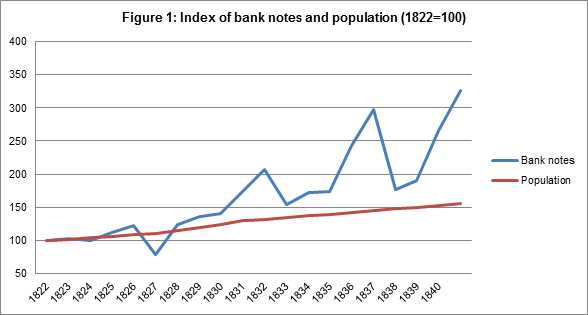
Le scénario que je viens de vous décrire est exactement celui qui se produisait au Bas-Canada avant la révolution des patriotes. Est ce qu’il y avait une augmentation de la masse monétaire?

MoneySupplyCheck! Surtout que cette mesure est conservatrice puisqu’elle n’inclut le crédit privé qui selon toutes les sources a augmenté (le crédit fait parti de ce qu’on appelle le “broad money” et fait parti de “M” mentionné plus haut). Tout indique que la masse monétaire en espèces était stable. Au final, la masse de monnaie augmente plus vite que la population – et de beaucoup. Avons-nous aussi un déclin du niveau général des prix suivant à un rhytme équivalent à l’économie la plus prospère de l’époque?

PriceLevel

Check! Les prix au Québec diminuent à une vitesse annualisée équivalente à ceux de la Grande-Bretagne qui à cette époque une augmentation de la masse monétaire (voir ici) et une croissance économique soutenue. Théoriquement, il est donc impossible que le Québec aille vécu une croissance économique négative entre 1815 et 1840. Il est possible que l’économie aille subie une série de chocs et que le revenu aille été volatile. Il est possible que la croissance aille été lente. Mais il est complètement impossible que la croissance aille été négative.

Ceci ne résout pas le débat, mais l’argument présenté ici est simple et démontre à l’intérieur de quels paramètres la recherche sur l’histoire économique (et par conséquent le “backdrop” de l’histoire politiquedevrait s’effectuer. Et clairement, les paramètres de la recherche ne devraient pas inclure la possibilité d’une crise économique continue et soutenue.

Peasants weren’t dumb: productivity and saw mills in Lower Canada

For those who follow my research on New France and Lower Canada (Quebec before 1867), I recently presented a working paper which discusses the level of agricultural production given alternative form of employment. This was meant to reinforce the literature about the capacity of peasants to respond to market signals and get a better idea of their true level of living standards. I found that where alternative forms of employment to farm activities  (or that could complement farm income) were present, the production of grains was significantly lower than where no such alternative existed. In short, households were smart and they shifted inputs in order to maximize income. The results were statistically significative only for sawmills – which were the main source of non-farm employment. However, these results concerned a fixed point in time – the census of 1831. It was merely the use of a cross-sectional dataset which had rarely been used before.

What about the same logic over time? The problem with Quebec before Confederation is that censuses are rare, of varying quality and of limited scope with regards to data. There are very few continuous dataseries. However, in continuing other research I had the good fortune to find a data source that allows me to compute a reliable estimate of production of a large number of parishes in the late 1780s and early 1790s (see source below).  This gives me the amazing possibility of combining this dataset with the datasets regarding prices throughout the years of British rule in Quebec and the sample I collected from the 1831 census. Results? I can regress productivity growth in grains harvested per person (measured in shillings held constant to 1860) over the number of sawmills from the late 18th century to 1831.

First of all, the rate of productivity growth is impressive and allows me to confirm my dismissal of the claim that Quebec’s economy was living through a crisis in the early decades of the 19th century. The compounded annual rate of growth between those years and 1831 stands at 0.4% per annum (which is slightly lower than estimates about agricultural productivity in New England) and confirms my earlier estimates of productivity growth in the Trois-Rivières area at 0.31% per annum. In fact, estimates of growth measured in calories that I tended to use in the past was a conservative one – 0.27% for the entire colony between 1788-1790 and 1831 and 0.1% in the Trois-Rivières area between 1762 and 1831. Clearly, Lower Canada was hardly living through an agricultural crisis. 

Secondly, the rate of productivity growth was negatively affected by the number of sawmills found in a given parish in 1831. Regression analysis yields the following results. They are not perfect, but one additional sawmills per 1,000 inhabitants in 1831 meant that productivity growth between 1788-90 and 1831 was 0.119 percentage slower than it would otherwise have been. The sample of 84 parishes represents some 60% of the colonial population, more than sufficient to induce the broad reliability of the results.

Peasants in Quebec were not as dumb as people claim them to be. If I am critical of the thesis of no growth or negative growth, I admit that growth must have been slower than in the United States (maybe as fast as that of the Southern States) or than in Britain. However, that poor rate of growth was not the result of poor household decisions by peasants and that rate is greatly underestimated by the lack of consideration given to the ability of peasant households to shift inputs.

StatisticallySignificant


Data Source:

Thomas Wien. 1985. “Visites paroissiales et production agricole au Canada vers la fin du XVIIIe siècle” in Sociétés villageoises et rapports villes-campagnes au Québec et dans la France de l’Ouest – XVIIe – XXe siècles. Trois-Rivières: Centre de Recherche en Études Québécoises, Université du Québec à Trois-Rivières, p.183-194.

In Canada, austerity is so 1990s

Like Brian Adams, austerity in Canada is a something of the 1990s. I am saying this because so many groups are now claiming, like the NDP is, that the conservative’s government commitment to a balanced budget is gonna hurt the economy and that this is “savage austerity”. The problem is that austerity was pretty much a 1990s thing…

Austerity

Its pretty clear, the vast majority of the spending cuts realized in Canada were done in the years of liberal rule. What the conservatives did (and I am not a big supporter of the conservatives given many of their regulatory decisions and the census decision) is that they hiked spending during the recession. Some part of that hike was “automatic”, the majority was not. However, the conservatives continued with scheduled tax cuts in order to avoid any modifications in the expecations of markets which had been promised a series of tax cuts since the days of the liberal rule (the much debatted 2011 corporate tax cut was in fact a liberal decision). Hence, most of the effort now done to balance the budget is done at a much lower level than in the 1990s and is mostly based on the expenditures side.

Cleaning up spending racked up during the recession while keeping the tax burden stable or slightly declining is not what I would qualify as “hardcore austerity”. The claim of hardcore austerity today doesn’t hold up against austerity observed in the days of the “neoliberal and market-loving” Jean Chrétien (hear the irony of clichés)

And if it is “austerity”, its one of the good kind as underlined by Alberto Alesina since the “good ones” are generally based on expansionnary tax cuts and reductions in public spending.

Government policies creating inequality between ♂ and ♀

Parental

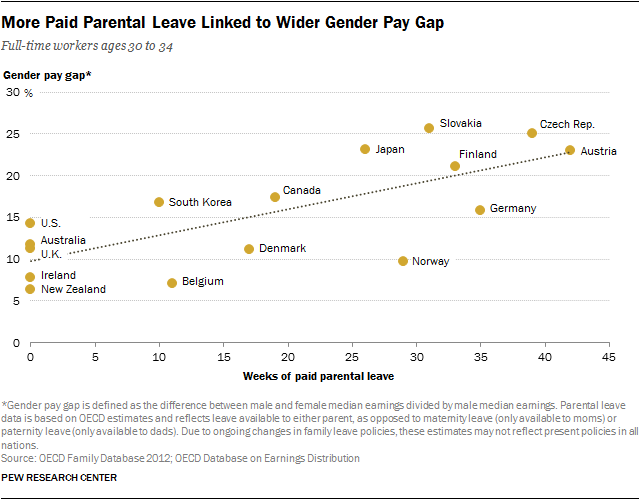
Look at this graph, look at it closely. What does it say? Where government programs create parental leaves program paid for by employers, the wage gap between women and men in their early thirties is greater and the longer the duration of these payments, the greater the gap grows. How does this hold econometrically? Relatively well.

Longer maternity leaves in Germany have lasting effects on the long-term earnings of women. However, the expansion of maternity leave programs did not have any lasting negative effects on the long-term supply of labour of female. In short, women were incited by government policy to stay longer off the market which had a detrimental effect on long-term wages. This seems to hold across Europe as a whole (here).

But more simply, it creates inequality. That government program incentivizes families to reduce the time spent at work at the expense of future earnings. Whilst as a society, we might value the presence of mothers at home (and hence value maternity leave programs) but we have to understand that this comes at a cost : higher inequality between male and female.  This is the case because longer periods spent off the market have a large effect on the wage gap. As the OECD recently explained in a 2013 paper :

However, if employees take up very long leave entitlements, they may become detached from the labour market as their skills depreciate. They might also have trouble getting the same job back.1 Moreover, the extent to which leave mandates produce positive outcomes for women also depends on how employers respond. Some may be reluctant to hire women, whom they perceive as more likely to take leave, if similarly qualified male workers are available. They may also seek to keep women in jobs where time off has a limited impact on the production process or where it is relatively easy to replace them. Plainly, however, the different perspectives on the labour market outcomes of paid leave mandates make it difficult to draw conclusions with any certainty as to the overall effect.

This conclusion would hold even if the policies were “equalized” to incite men to stay at home in equal proportions to women because the wage gap between men would grow (logically, unless men across the income distribution chose to stay at home in proportions representative of their income – something I find unlikely) . If governments want to have policies that will increase the incentives to have kids – programs like parental leave – they must understand that the counter-effect is that they end up generating inequalities that they will condemn. You may want that policy – I don’t think it’s a terrible policy (in principle) – but you can’t complain about the results you knew you were going to get.

When I scream out my lungs that governments are much better at creating inequalities (that they will then condemn) than they are at reducing them, this is a good example.

H/T : Francis Pouliot