Market integration in Quebec, 1795-1889

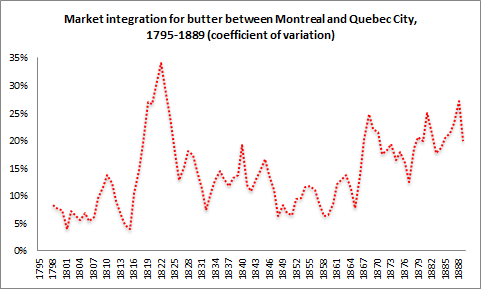
In writing about other things related to my research on pre-confederation economic history in Canada, I discovered datasets that allowed me to study prices across regional markets for butter from 1795 to 1889. The results I found were surprising because I expected the direction to run in the opposite direction, especially after confederation because of the expansion of road networks, literacy, international trade and railways. Yet, the markets of Montreal and Quebec are widely divergent with prices in Montreal being systematically higher than in Quebec.

MarketInter

Why would prices be higher in Montreal systematically leading individual farmers to make use of arbitrage possibilities? Exports markets are not an answer since the quantity of butter exported per capita exhibits a downward trend and there are more imports of butter than exports of butter. Clearly, something is preventing market integration, especially after confederation. Notice that from the end of the Anglo-American war of 1812-1815, the trend is downwards (meaning less divergence between markets) and the uptick begins in the early years of confederation.

For economic historians, there is something happening there that is worthy of studying and could yield possibly interesting nudgets about Quebec’s poor economic performance in the early days of Confederation.

Economics of Star Wars (On currency exchange)

This weekend, my much better half had the great idea to suggest that we watch one of the episodes of the Star Wars trilogy. Since she was new to Star Wars, I proposed to start with the Phantom Menace. While watching, I was really surprised at how George Lucas created a story from nothing.

Basically, since 60% of the movie happens on Tatooine because nobody will accept Qui-Gon’s credits (republic dataries) because the Republic has no reach in that sector. This got me thinking: isn’t there any foreign exchange markets? The storyline is set in a galaxy of thousands of star systems whose economies all seem to be well-integrated through interplanetary trade and instantaneous communications across light years, but George Lucas is telling there is no foreign exchange markets? I mean, I can buy Zimbabwe’s currency for US dollars, but George Lucas can’t have a jedi master sell Dataries for whatever currency of choice?

Tatooine is a developping economy by the looks of it and one which is rife with criminality. In the movie, we hear about another currency while Jar Jar Binks (George Lucas’ worst creation) steals a piece of meat from the market : the wuipiupi. It seems that most exchanges occur in that currency. I googled that currency’s name with references to Star Wars and it only seems to be used only onTatooine – in the Phantom Menace and A New Hope. By all standards, it is not a  popular currency. Developing economies have a tendency to demand more foreign currency deposits than developped economies, notably because the currencies of developing economies are less stable. The lack of credibility of these currencies is often the main issue (see here). Moreover, criminals like Jabba the Hutt would tend to have their assets denominated in a safer and more stable currency than the Wuipiupi. All of this explains why I was stunned that there were no foreign exchange market or at least, no black market for foreign exchange (whose absence, given the criminality on Tatooine, is even more surprising). 

Basically, the Phantom Menace movie would have been 55 minutes shorter if markets had existed, we would have been spared 55 minutes of Jar Jar Binks and the story could have focused on another way to introduce Anakin to us.

UPDATE : I’ve discovered something which makes EP1 even worst in terms of credibility. According to Wookiepedia, the Wuipiupi was actually pegged to Galactic credits at 0.65 wuipiupi per credit. If you peg a country’s currency to another currency, it is virtually impossible not to have any forms of black market for foreign currencies – especially the peg does not reflect economic fundamentals.

UPDATE 2 (a comment by Frédéric Boiteau):  If Tattoine had a foreign currency exchange market, they wouldn’t have met Anakin and Palpatine would have remained a no-name senator from a backwater planet that would eventually have been investigated after the crippling embargo of the Trade Federation had caused enough economic damage. It would have been discovered that he used his office of secretly fund the Trade Federation and instigate the conflict on Naboo. The Jedi, having been sent there to try and force a resolution, would be involved in the investigation and likely discover Palpatine was actually hiding his true identity as Darth Sidious.  He would have then been killed by the Jedi, and the Old Republic would have remained. With Sidous’ plot foiled, the entire conflict leading to the Clone Wars would have been avoided, with Count Dokuu going into hiding and biding his time until he could find a new appentice and remain in hiding…

Quebec is not a slow-growth-high income region, it is merely slow growth

The article below is a reply to a good colleague of mine to his article on the Québécois Libre 


In a recent article in this webzine, fellow economist Jean-Luc Migué argued that Quebec’s economic catchup on Ontario was the result of changes in the distribution of the population. His logic is that the faster pace of population growth in Ontario (relative to Quebec) generated an increase in the price of land (rents) that was much faster in Ontario than in Quebec. This meant that, once you adjust for prices, Quebec has converged towards the level of living standards observed in Ontario in spite of slower economic growth. According to that logic, it is easy to explain the fact that real income per capita in Quebec has increased faster than productivity in the last few decades. This argument is well supported by economic historians and appears to be true. However, it is not because it is true that it explanatory power is sufficient to explain a large part of the economic reality.

While the mechanism described by Mr.Migué (and his colleague Gérard Bélanger in another paper) may be true, the consideration of other factors overwhelms the size of the effects of this mechanism. In reality, the income level of Quebec is greatly exaggerated and the differences in the cost of living are also overestimated while also being theoretically misunderstood.

How great is the cost of living gap between Quebec and Ontario?

The statistics presented with regards to the cost of living differences between Quebec and Ontario are not provincial averages. More often, they are differences between Montreal and Toronto which we take to mean as provincial differences. On average between 2000 and 2009, the gap between Montreal and Toronto stood at 13.4%.[1] The problem is that these are hardly representatives of provincial averages. Once we try to account for the weights of other cities, the gap becomes much smaller. Martin Coiteux estimated that in 2009, the provincial differences stood at less than 6%.[2] Estimates of the “basic needs” poverty line which compares identical baskets of goods and services to insure a modest but decent standard of living compiled by Chris Sarlo is also a good approximation of the gap in prices. It shows that in 1988, that difference stood at 9.7% and that the entire difference was explained by cheaper housing since food and clothing were more expensive in Quebec than elsewhere.[3]  So the gap between Ontario and Quebec is much smaller than we are led to believe.

Low housing costs are the result of differentials in quality

Most of the argument put forward by Migué rests on the price gap for housing in Quebec and Ontario. Howerver, the problem is that the demand for housing is itself a function of real income. When one chooses a residence, he fixes a price for monthly payments that he believes to be able to assume. This threshold is drawn in function of what the remaining income will buy in terms of food, clothing, transports and other goods & services.  If income across regions is different but all non-housing goods are equally priced, the cost of “average” housing will be different. However, these differences will be mostly explained by differences in the quality of housing. In short, higher income areas will require more expensive housing.[4]

Once we disaggregate the data, we find that Quebec has similar prices to Ontario with regards to non-housing goods and services. In his article, M.Migué admits as much when he points out that 90% of the price gap between Montreal and Toronto is explained by housing costs. But a further look at the data is even more convincing; Quebeckers pay a higher price in nominal terms for identical food baskets, gasoline (before taxes) and identical clothing items.[5] Given the much lower level of nominal wages in Quebec, this means that Quebeckers actually have a higher cost of living than Ontario since they must work longer hours for identical goods. Moreover, the price gap between Ontario and Quebec is heavily distorted by the effects of subsidized prices for services like electricity, daycare and university tuition. All of these items share equal weights in the calculation of the price indexes for Quebec and Ontario, but they are cheaper in Quebec because of a deliberate policy to reduce artificially the price of these services. However, these must be compensated by higher income taxes, corporate taxes and payroll taxes which are not captured by the different price indexes.[6] This creates the illusion that prices are lower in Quebec when in fact they are not, they are merely assumed differently. So, in reality, the totality of the cost of living difference stems from differences in the cost of housing.

So, what we spend with regards to housing (and thus the average cost of housing) is determined by the real income left to Quebeckers after all goods and services needed are assumed. Lower incomes mean lower housing costs because of lower quality housing. And when you look at the data on the quality of housing in Quebec, there is a considerable lag. The average number of rooms, bedrooms and bathrooms is lower in Quebec than in Ontario. The homeownership rate is 10 percentage points below that of Ontario even if the rate of owned houses with mortgages is equal in both provinces. Households in Quebec also sacrifice on complementary housing goods like internet connections, cable television, personal computers, microwaves, dishwashers relative to similar households in Ontario. [7] Not only are Quebeckers less prone to become homeowners, what they rent is of much lower quality than what Ontarians rent. A 2004 study published by Statistics Canada shows that rents in Montreal less often include running water, heating, electricity, parking spaces and appliances than Toronto rents.[8]

If we were to assume that, exogenously and without any increases in income, Quebeckers would change their housing quality preferences to match exactly that of the Ontarians, rents would increase dramatically and most of the price gap discussed by Mr.Migué would vanish.

Quebec is less productive and hence poorer

On average, Quebec workers are less productive than Ontario workers which translate in lower hourly wage rates. Consequently, workers in Quebec must work longer hours than workers in Ontario for identical goods. For example, the average Montrealer must spend 18.7% more time at his job to acquire an iPod 8gb than the average Torontonian.[9] The average Quebec worker must also work 22 hours more than the average Ontario worker to acquire 100 liters of gasoline (before taxes), 29.5 hours more for the acquisition of the food basket recommended by Health Canada.  This applies to services as well since Quebeckers must, on average, work 24% more for a cab fare of 8km and 15% more for a haircut.

Moreover, most of the convergence on a per capita basis in real incomes between Quebec and Ontario is the result of changes in the structure of households. The size of Quebec households has fallen faster than that of Ontario households. The thing is that larger households have economies in scale in their purchases which increases their real purchasing power. This creates a statistical illusion that is biasing down income estimates in Ontario relative to Quebec. When we correct for this using the methods proposed by Statistics Canada, we find that Quebec’s per capita income in 1976 stood at 77.73% of that of Ontario. By 2006, it had merely increased to 78.01% – indicating a virtual stagnation over three decades.[10] Not only that, but that figure was higher in 1961 (before the Quiet Revolution) than in 1976 since it stood at 78.31%.[11] These results were confirmed by Martin Coiteux, with a different methodology, who points out that the Quebec’s per capita income stood at 85.9% of Ontario’s in 1976 compared to 79.9% in 2006. Using these statistical adjustments, we find that the growth Quebec’s per capita income matches the slow pace of productivity increases.

The virtual stagnation relative to Ontario is indicative of the lack of success of the statist model of Quebec to generate economic convergence. It mirrors the slow pace of productivity increases whose slower pace of increase is compensated by interprovincial transfers to Quebec.  The sad but real fact is that Quebec is not a slow-growth and high income region, it is merely a slow-growth region.


[1] Vincent Geloso. Forthcoming in 2014. Coûte-t-il vraiment moins cher de vivre au Québec? Le coût de la vie au Québec relativement au reste du Canada. Montréal : Centre sur la Productivité et la Prospérité à HEC Montréal.

[2] Martin Coiteux. Le Point sur les Écarts de Revenu entre les Québécois et les Canadiens des autres Provinces, Montréal, Centre sur la Productivité et la Prospérité à HEC Montréal, 2011. p. 12.

[3] Christopher Sarlo. Poverty in Canada — 2nd Edition, Vancouver, Fraser Institute, 1996. p. 115

[4] For a deeper discussion of the issue, consider the following articles:  Michael E. Stone. 2006. “What is Housing Affordability? The Case for the Residual Income Approach” Housing Policy Debate, Vol.17, no.1, pp.151-184; Donald Haurin. 1991. “Income variability, homeownership, and housing demand” Journal of Housing Economics, Vol.1, Issue.1, pp.60-74; Orazio Attanasio, Renata Bottazzi, Hamish Low, Lars Nesheim et Matthew Wakefield. 2012. “Modelling the demand for housing over the life cycle” Review of Economic Dynamics, Vol.15, issue 1, pp.1-18.

[5] Vincent Geloso. Forthcoming in 2014. Coûte-t-il vraiment moins cher de vivre au Québec? Le coût de la vie au Québec relativement au reste du Canada. Montréal : Centre sur la Productivité et la Prospérité à HEC Montréal.

[6] Vincent Geloso. 2013. Du Grand Rattrapage au Déclin Tranquille : Une histoire économique et sociale du Québec de 1900 à nos jours. Montréal : Accent Grave, chapter 3.

[7] Statistics Canada. 2013. CANSIM tables 203-0027 and 203-0019. Ottawa: Statistics Canada. Available online at www5.statcan.gc.ca/cansim/home-accueil?lang=fra

[8] James Chowhan et Marc Prud’homme. 2004. City comparisons of shelter costs in Canada: A hedonic approach. Ottawa: Statistics Canada, pp. 21-24.

[9] Andreas Höfert et Daniel Kalt. 2012. Prix et Salaires : Édition 2012. Zurich : Union des Banques Suisses, p. 8.

[10] Vincent Geloso.2013. Une perspective historique sur la productivité et le niveau des Québécois: de 1870 à nos jours. Montréal : Centre sur la Productivité et la Prospérité à HEC Montréal.
What Would James Buchanan Say About Inequality?

As many of you can see from my recent blog posts, I have decided to jump in the inequality debate (albeit with a focus for the subnational Canadian levels) by trying to assert which part of all inequalities should we be really worried apart. In response to my point that some of all the inequalities observed (a large part in my opinion) are not morally offensive, many reply that even those inequalities might create more “undesirable” inequality because (in the words of Miles Corak) “outcomes influence process“.

To a fan of public choice theory like myself, this theoretical argument has some appeal. The logic goes that the richest of the rich will be able to lobby more efficiently for policies that might create more inequality of the “undesirable” kind. Rich voters are often part of certain interest groups. These groups ask, amongst other things, for trade tariffs, entry regulations, subsidies, bailouts and obtain government contracts. So the argument that past outcomes (read: all inequalities) shape the process that will lead to future outcomes (read: more inequalities). And the vicious circle goes on.

The problem I have with this interpretation is that of the root of causation and the direction. I don’t believe that the link goes from inequality to government lobbying, but the reverse where government lobbying leads to more inequality. This forces me to return to a re-read of the late James Buchanan on inequality:

Are there any reasons for believing that the political order will generate a more nearly equaldistribution of income than a free market would generate (as seems to be commonly assumed)? What “rules” of political order are likely to generate more “equitable” outcomes? (…) But distributions are not chosen. Social outcomes, with their distributional characteristics “built in,” emerge from a complex interaction of individual agents, each pursuing his own ends and each connected to others under a set of prevailing rules.

In short, the rules of the game will define the levels of inequalities, both ethical and unethical. If you change the rules, not the inequalities, you will change the game.

If the rules of the game are that the Federal Reserve bails out bankers who took considerable risks at the expense of taxpayers, of course you will get more inequality. This was well-emphasized by Tyler Cowen in his survey piece when he pointed out that banking strategies were only sustainable under credible commitments from federal authorities that these banks would be bailed out and/or protected from assuming the totality of the risks they assumed. This grew profits beyond the social optimum point and attracted workers (of the most productive brand) into this industry which was bubbling.  The same can apply to managers of automobile companies who lobbied for bailouts after decades of poor managerial decisions but who still obtained large bonuses, severance packages and payment plans. Because of their wealth and influence, bankers and managers were well-placed politically to lobby Congress, the Federal Reserve and other political decision-makers in their favour.

Then, the solution to these morally reprehensible inequalities is not to redistribute the income of these richer individuals but to stop the root causes of these inequalities! The public choice argument in the inequality debate is to change the rules of the game, not to redistribute the fruits of the badly played game.  If James Buchanan was still alive, I would expect him to say that ending the commitment to too-big-to-fail would stop incentivizing the distribution of income in favour of politically connected financial executives.

Pourquoi les inégalités de revenu sont peu pertinentes

Depuis plusieurs semaines, je publie de multiples billets sur le sujet des inégalités économiques.  Je suis beaucoup plus optimiste sur le sujet que plusieurs notamment à cause des importants changements qui se produisent dans la structure économique et démographique des sociétés occidentales. Selon moi, les gens observent en grande partie le résultat de changements démographiques importants.

Depuis les années 1970, la population étudiante a augmenté de manière importante tout comme la population la plus âgée.  Les gens âgés sont non seulement plus nombreux, mais ils prennent leur retraite plus tôt. Ce faisant, ils font augmenter l’âge moyen du groupe du 10% le plus pauvre de la population. Ceci ne veut pas dire qu’ils sont pauvre. Même si ils n’ont plus de “revenus”, ils ont encore des épargnes et leur niveau de consommation est plus bas puisque les grandes dépenses de vie (hypothèques, enfants) sont déjà passées. Difficile de les classifier comme “pauvres”. Quand on regarde les distributions économétriques du revenu selon l’âge (a ceteris paribus), on réalise que le revenu subit une baisse dramatique au début de la soixantaine, ce qui correspond à la retraite (voir ici).

En plus, la population étudiante grandissante et la durée grandissante des études change la forme de la fonction des revenus sur une vie. Le sommet d’une telle courbe (qui a la forme d’une bosse) arrive donc plus tard, ce qui devrait augmenter l’âge moyen du groupe le plus riche de la société (selon les revenus).

Comment illustrer ceci? L’âge moyen du décile le plus pauvre et du décile le plus riche entre 1969 et 2009. Selon les données des enquêtes de Statistiques Canada, le décile le plus riche du Québec est en moyenne plus âgé en 2009 qu’en 1969 et le décile le plus pauvre s’est rajeuni légèrement (reflétant la grandissante population étudiante). Ainsi, la “bosse” est devenue plus asymétrique. Elle s’est abaissée à des jeunes âges (reflétant la population étudiante grandissante), le sommet s’est déplacé vers la droite (plus âgé) et vers le haut et chute beaucoup plus rapidement après un certain âge qu’auparavant.

Age

Les statistiques sur le revenu ne peuvent pas capturer adéquatement ces changements dans les préférences temporelles des individus aussi bien que d’autres mesures. Ceux qui se concentrent sur les inégalités de revenu ne considèrent pas l’importance des changements démographiques qui sont encore en cours et qui impliquent aussi des changements dans la structure et l’expression des préférences des individus quant à leurs revenus à travers le temps. Le sujet est bien résumé par l’économiste Tyler Cowen :

The broader change in income distribution, the one occurring beneath the very top earners, can be deconstructed in a manner that makes nearly all of it look harmless. For instance, there is usually greater inequality of income among both older people and the more highly educated, if only because there is more time and more room for fortunes to vary. Since America is becoming both older and more highly educated, our measured income inequality will increase pretty much by demographic fiat. Economist Thomas Lemieux at the University of British Columbia estimates that these demographic effects explain three-quarters of the observed rise in income inequality for men, and even more for women.

Il faut donc éviter de mettre trop d’emphase sur le sujet des inégalités de revenu et se concentrer sur une autre mesure tel que les inégalités de consommation qui semblent plus à même d’estimer adéquatement le niveau de vie (de long-terme) des individus.