Austerity: home grown vs. foreign

With the recent defeat of the left-wing party that enacted the austerity program in Greece, numerous are those who claim that the end of austerity has arrived. Personally, I see something different. What I see is the story of “homegrown institutions” vs “institutions imposed by foreigners”.

The austerity plan applied in Greece was imposed from outside Greek society. In Greece, it is Germany that bears the blame entirely. As Albrecth Ritschl of the LSE has emphasized, Germany was the biggest debt transgressor of the 20th century and lived a “greek” lifestyle sustained by credit for many years. It’s hard to blame the Greeks for thinking that the Germans are not ideally suited to tell them what to do.

Still, with record levels of public debt to GDP and spending levels with endemic growth, its hard to do anything else than cut and liberalize. Then why does austerity backfire? Its a question of “endogenous” versus “exogenous” institutions.

The success of vast institutional reforms (privatization, deregulation and spending cuts) is a function of these reforms in relationship with indigenous agents. The former institutional setting was linked to local agents who formed this setting to reflect their respective interests. Any reform imposed from outside ignores the issue of credibility and workability with these local agents. The new set of institutions – even if it is factually better to attain more desirable outcomes – generates less adhesion. In fact, imposing reforms from abroad is likely to create a greater cohesion between interest groups in favour of the status quo.

By imposing austerity from Brussels and Berlin, the members of the European Union have vastly overestimated their capacity to generate long term growth and underestimated the role of internally driven change to creating prosperity. Politically and economically, it would have made more sense to exclude Greece from the Euro zone and let them adopt the measures necessary in a manner that is acceptable to the different voters in Greece.

Recently, Alberto Alesina and Francesco Giavazzi asserted that “how” is austerity done matters as much as “how much” austerity is applied. Maybe we should propose to add “by whom” is it applied to complete their discussion.
Une dette pour un investissement

Entre 1990 et 2005, les frais de scolarité au Canada (même en incluant le Québec) ont grimpé de 1,464 $ à 4,214$ (en tenant compte de l’inflation). Il s’agit d’une augmentation de 188%. Ces hausses ont causé une augmentation importante de l’endettement des étudiants. Selon l’avis des grandes fédérations étudiantes, il s’agit d’un problème.

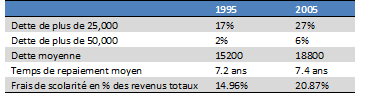
J’aurai tendance à dire que l’endettement serait effectivement devenu un problème pressant si la période de temps nécessaire pour le remboursement desdites dettes avait augmenté. Ce n’est pas le cas. Malheureusement, je n’ai pas de données qui me permettent de regarder la période moyenne de remboursement d’un prêt étudiant en 1990. Toutefois, une étude de Statistiques me permet de comparer 1995 et 2005 à cet égard. Le graphique suivant illustre la réalité:

Comme on peut voir, la part que les étudiants doivent financer de leurs études a augmenté dans le Canada , que la dette moyenne a augmenté et que les “gros prêts” ont augmenté eux aussi. Néanmoins, la période de remboursement est restée sensiblement stable. En plus, quand on regarde de plus proche, on remarque que pour certains groupes ces proportions ont diminué. Le pourcentage de femmes prévoyant rembourser leurs dettes étudiantes en plus de 10 ans est tombé tout comme le nombre d’années moyen que les diplômées ont besoin pour rembourser leurs prêts.

Ce qu’il faut comprendre, c’est que ces données illustrent quel’éducation est un investissement.Avec une demande grandissante pour l’éducation supérieure sur le marché du travail, le rendement des études demeure élevé et continue même de croître. C’est ce qui explique l’augmentation des dettes avec la stagnation des périodes de remboursement.

Alors oui, le problème de l’endettement soulevé par les fédérations étudiantes relève de la mythologie politique…

Economic growth in Canada and the United Kingdom between 1695 and 1739

When the French decided to settle Canada, they decided to establish a system of property rights that … well…wasn’t really a system of private property rights. The land holding system as defined under the “Coutume de Paris” was feudal in nature.  It was a segneurial system under which the land owner was a seigneur who would rent parcels to settlers. These settlers were called censitaires and they did not possess the land and they not had to pay their cens et rentes for the land the use of common installations like a windmill or watermill. It would be false to assume that there was a unified legal construct that regulated this feudal system of land holding. Seigneuries were rarely traded formally, in fact, one must wonder whether a market for land truly existed. It seems like there was an informal market for a time, but measures were enacted in 1711 to put an end to it.

Moreover, the monetary system was based on … playing cards. The money supply would only come at spring via the St-Lawrence River in the form of a ship filled with currency. Problem was that the governor had to pay his administrators and troops with something, so he took the playing cards in the province, signed them and promised to repay them. Sadly, they could not all be redeemed. This occured on many occasions and only ended once the British took control of the Province.

Hence, let us ask ourselves how did Canada perform economically at the time relative  to other places in the world. I have not been able to find a data set for France – the mother country with regards to GDP. But I did find a data set for Canada (published by Morris Altman in the William and Mary Quartely) and for the United Kingdom (on MeasuringWorth.Com). Here is the result and I am not sure what to make of it at this point, it does seem that Canada was not seriously disadvantaged economically by the French system. If anyone knows data for the United States or/and France for the same period, please tell me. Otherwise, this is interesting and has not been made as of now.

Institutional transplantation in Québec at conquest

The importance of Quebec for the British empire is often underlined. However, since its main waterway – the Saint-Lawrence River – is the gate for the inner parts of Canada coming from the east, it was crucial to conserve the colony and prevent its rebellion or defection to the Americans. Nevertheless, the case of Quebec within the British Empire has been vastly understudied even if it could yield powerful explanations as to how England designed policies and institutions to minimize the risks of defection and rebellion.

In fact, French Canadians were quite loyal. They formed volunteer batallions to fight the rebels of Pontiac, they assisted the British in the first American invasion and formed the bulk of the army that defeated the second American Invasion at Chateauguay. Why would they not defect? Did the institutional choices made by London for the newly conquered colony had any effect?

And Institutional reforms they did enact! They stabilized the currency market and stopped the practice of “playing card money” which stopped the galloping inflation, they abolished monopolies on fur trading, they partially reformed the property rights system, reduced government expenditures and they opened up the colony to trade with the thirteen colonies.

Did these institutional reforms generate conditions that were favourable to elicit trust from the French Canadians (growth or rent seeking for elite merchants)? . Those who discuss this issue often make use – openly – of a marxist framework of analysis. For those who don’t, the vast majority does make use of insights from New Institutional Economics and the role of institutions. The main exception are Robert Armstong and Marcel Trudel.

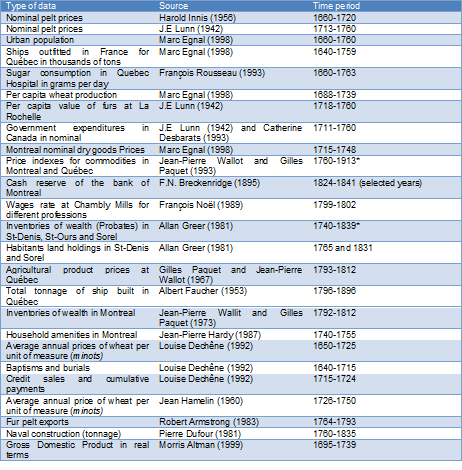
It seems that there is something to be said there, but why has no one jumped on it? It isn’t for lack of data! In fact, the table below gives a good image of the available data. None of that data actually spans over a period that overlap the French and British regimes (at the exception of those with an asterix next to the time period) . The original sources (primary ones) are easily accessible and could be collected and amalgated together to obtain a wide portrait of the economy of the colony at the time of the Conquest.

If one wonders how the British Empiresustainedits conquests, it is hard to avoid the question of how they implanted new institutions in conquered societies and under which constraints they did so. The case of Quebec is probably the most interesting to answer this question of how British goverments made choices with regards to the transplantation of institutions in order to keep the sun shining forever on their realm.

Probability and PHD comics

Yes I know, I am about to make a comment on PHD comment (not for Philosophae Doctorae but rather for Piled Higher and Deeper), but there is a factual error in this comic : If the probability stays constant, then an idea should eventually appear out of thin air. If for every second I stare at my computer, there is one chance out of one million that an idea will emerge, then I will have an idea once every 16,667 minutes (once every 278 hours).

Yes, I am that bored…