What are excess profits ?

What are excess profits? How do we define them ? Companies that produce goods and services that we will demand regardless of price (oil and pharmaceuticals) are believed to be benefitting from the ineslaticity of our demand and hence charging us excessive profits. However, what would you say that periodicals publishers and book publishers have higher profit margins than oil producers and refiners?

I took the time to use Yahoo! Finance to see how large (or small) are profit margins by industry. It is an interesting since oil and gas refining, generic drug manufacturing, oil and gas pipelines and major oil and gas integrated firms have net profit margins of 2.9 %, 4,7 %, 5.3 % and 6.8 %. This is compared with confectioners at 7.3 %, toys and games at 9.6 %, soft drinks at 14.2 % and periodical publishing at over 52%.

See the table below



Capitalist Peace : Wealthier and Safer

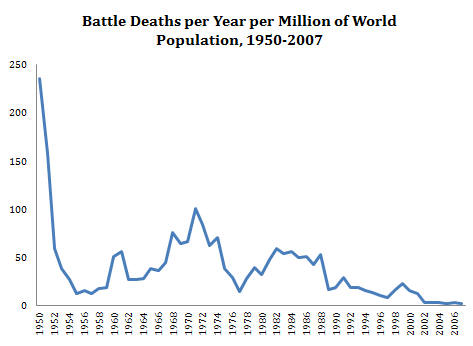
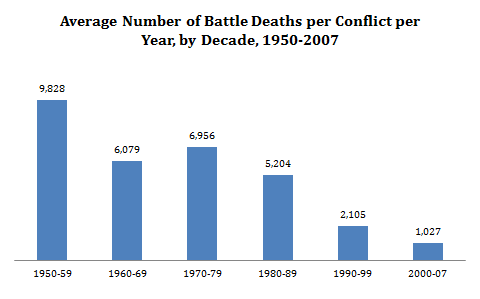
With my friend and colleague Pierre Simard from the École Nationale d’Administration Publique in Québec city, I have published an op-ed in the second largest french newspaper in North America, La Presse, arguing that free trade and free markets have made the world safer. In short, I argue the case of the capitalist peace. In reaction to the article, some have criticized our points despite quoting a vast series of econometric articles (from Erich Weede to Steven Polachek without forgetting Erik Gartzke, Alan Taylor, Reuven Glick and numerous others). So I have decided to include some graphics derived from the Human Security Report which show a reduction in violence since the 1950s – meaning since the beggining the Thirty Glorious, the reduction of formal trade barriers, the explosion of foreign investment, the reduction in transaction costs, cheaper communications and an increase in economic freedom.

Indeed, a safer world…

Note : All the data will be republished in my “data sets” section.

Income in Quebec according to language

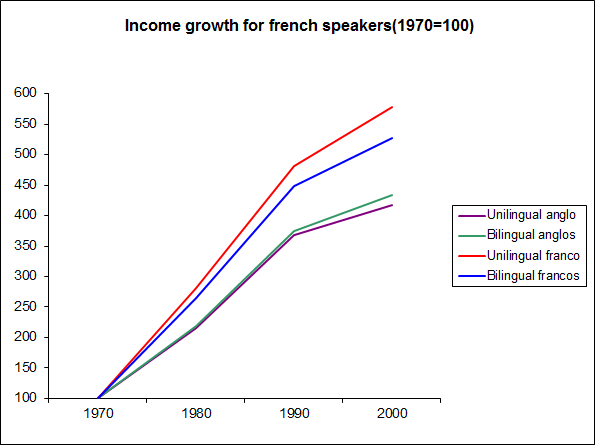
In my recent interview on CHOI Radio X, I mentionned that income growth for unilingual francophones in Quebec has been the the fastest of all linguistic groups since 1970. This claim has been questionned by some critics of mine. To dissipate any doubts about the validity of my claims, I am adding a new data set to this blog dervied from a 2007 paper by Vaillancourt, Vaillancourt and Lemay published at the C.D. Howe. I am also adding the two following graphs as evidence.

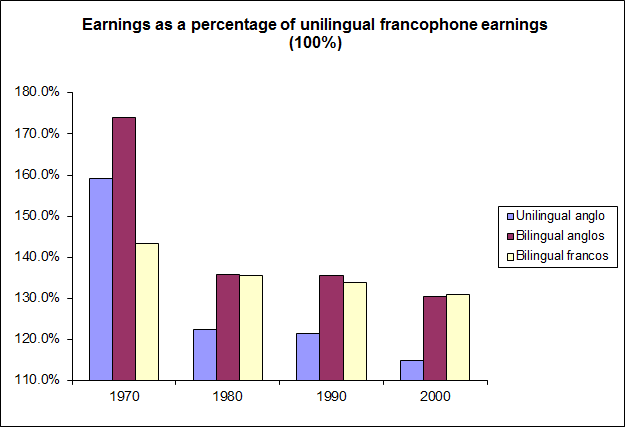
As we can see, unilingual francophones and bilingual francophones (first language) have the fastest growth of all since 1970. This means that we can see the following convergence in incomes as we can see in the following graph.

For those who are still skeptical of this claim of mine, you can also consult the 2008 article of David Albouy in the Canadian Journal of Economics which evaluates the wage gap betwen anglophones and francophones in Quebec since 1970. He, like Vaillancourt and al., arrives to the same conclusion regarding convergence in income.

Tommorow’s radio interview

With my vacations at a near end, I have to travel to Quebec city to visit some friends. It will also be an opportunity to make my weekly radio commentary in studio at CHOI Radio X (in french). However, in a rare turn of events, I will be spending a large segment of the show (maybe the entire show) in studio as a guest. If you wish to listen to the interview, please visit www.radiox.com

Stalin’s darkroom

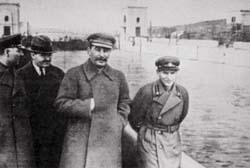
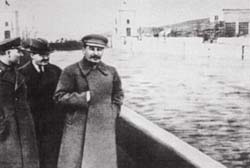
In the research for my piece on the commemoration of the dissolution of the Soviet Union, I fell on a 1998 article by historian Robert Conquest that I had never had the chance to read. In fact, neither in Harvests of Sorrow nor in The Great Terror did I find a mention of what he reports in the article. It makes a novel observation about the Soviet Union and … photography.

The purges of Stalin caused problems for official propaganda. If an individual that was sent to Kolyma died there and happened to be featured on an official picture, how to solve this problem to say that he never existed. Simple, you alter the pictures. In reviewing David King’s The Commissar Vanishes: The Falsification of Photographs and Art in Stalin’s Russia (that I have ordered because of this review), Conquest publishes some of the pictures of this “darkroom manipulation”. Here is one, I think it is quite telling.