Illustrating Wal-Mart’s rise from 1996 to 2010

How big is Wal-Mart? The answer is pretty big! The growth of productivity at Wal-Mart, matched by real wages growth, has allowed the corporation to cut prices systematically and provide consumers with a service they really desire. This has resulted in growth that is faster than the overall rate of economic growth.

This is illustrated in this graph below which represents the domestic sales of Wal-Mart in the United States as a share of GDP. The data set is available in the “data sets” section of my website and you can consult it freely.
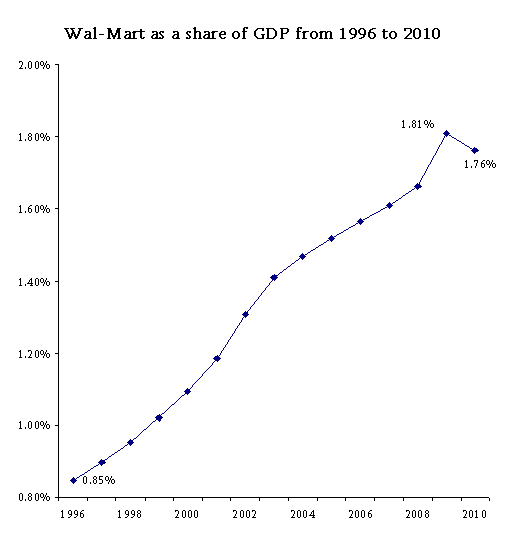
If you think that this rise is meteoric, consider that according to Cox and Vedder in their 2004 book entitled The Wal-Mart Revolution, in 1980 Wal-Mart’s sales as a share of GDP stood at 0.04%
New data set : wartime inflation

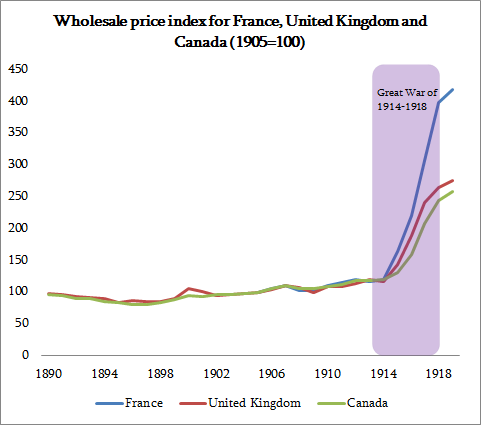
I have just gathered some data related to wholesale prices in three countries that were involved in World War 1 (1914-1918). Considering that military historians have a tendency to shun economic issues with regards to the study of conflicts, I believe that making this data available could be quite useful. It might be also interesting for military historians to consider two papers in economics about the financing of war.

The first is a paper by Lee Ohanian in the American Economic Review that surveys the way World War 2 and the Korean War were financed and what were the effects on the overall output production. All though not directly related to inflation in war, it does document the effects of issuing debt to finance wartime production. The second paper is in Economic History Review which surveys the war financing of both Britain and Germany and concludes that the latter’s monetary policy was by fare the most expansionnary and led to important inflation which in the long run threatened the economic future of Germany.

Without further delay, here is the data I have for you that you may now consult in the “data sets” section.

RIP: 2% American Growth Path (1870-2008)?

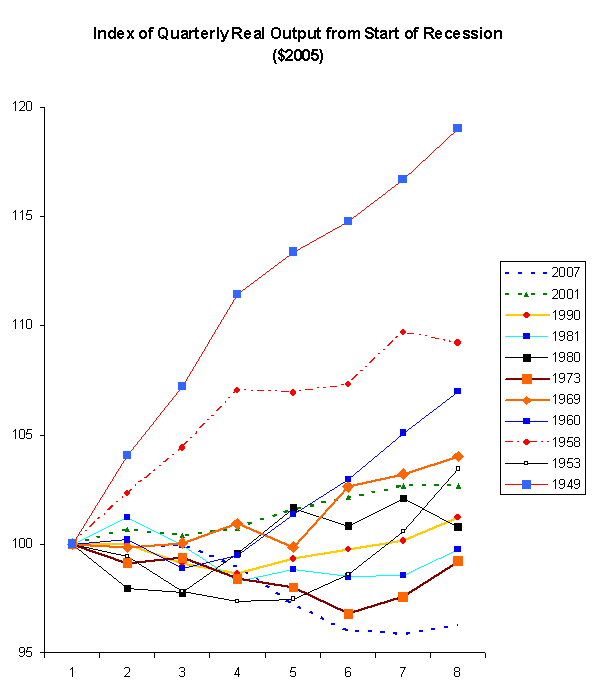
In a Wall Street Journal, Nobel Laureate Robert Lucas is quoted asking if it is “possible that by imitating European policies on labor markets, welfare and taxes, the U.S. has chosen a new, lower GDP trend? If so, it may be that the weak recovery we have had so far is all the recovery we will get.” It is by observing the growth path of the United States since 1870 that he arrives to such a conclusion.

The graph below illustrates the “recovery” measured by quarterly output measured by the Bureau of Economic Analysis. Indeed, it seems that the recovery is slower by historical standards.  I am not trying to hop on the band-wagon here, but the story seems plausible.

  1. On the one hand, the United States have been spending at a pace faster than economic growth since the end of the last century.
  2. On the other hand, the Welfare State in the United States has grown in the last two decades
  3. As in Europe, the government intervened to save corporations from bankruptcy, hence changing the incentives.

I  am not wholly convinced since little importance is granted to the uncertainty of investors regarding the policy environment. The debates over taxing rich taxpayers and business are casting some uncertainty.

But it seems that the possibility of America embarking on a new steady-growth path that is lower than its previous historical path is quite plausible.

SOEs in Saskatchewan

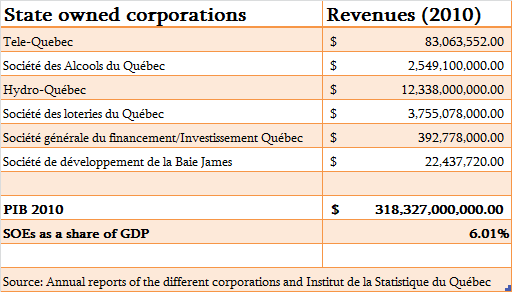
In continuance with a previous post regarding State Owned Entreprises (SOEs) in Quebec, I have assembled a new data that will allow to compare SOEs in Quebec with SOEs in Saskatchewan. Quebec and Saskatchewan are probably the two provinces in Canada that are seen by the general public as being highly “interventionistic” in the economy. Hence comparing them can be interesting as we can see in the table below, Quebec (with SOEs at 6.01% of GDP) intervenes less through SOEs than Saskatchewan does (at 7.23% of GDP).

However, I have failed to find data with regards to revenues of SOEs going back in time enough to evaluate the extent of the privatization trend in Canada, I can however do such a thing with regards to the federal government (a series that will soon be available for selected years 1980, 1990, 2000 and 2010).

Quebec’s SOEs as a share of GDP

One way to estimate the importance of SOEs (State Owned Entreprises) in a given economy is to take their revenues and simply transpose them onto the overall economy as measured by GDP. So I have applied the exercice to my home province of Quebec in Canada (and I intend to begin comparisons soon). This first set is available is my “data sets” section and will be updated regularly to include other nations, provinces or states.

As an interesting aside, everyone interested in the issue of privatization ought to read Netter and Megginson’s 2001 article in the Journal of Economic Literature concerning the results of privatization and the trends with regards to SOEs.  It is void of all jargon that might terrorize non-economic readers and is quite instructive with regards to privatization.