Quebec’s economic performance in the early days of Canada

In my most recent book, I document how economic growth (on a per capita basis) was slightly slower (or at best, it was on par) in Quebec than it was in Ontario from 1900 to 1940. I showed that living standards remained roughly 25% to 30% inferior in Quebec. I also argued that productivity growth was also considerably slower in Quebec which contributed to this disappointing performance.

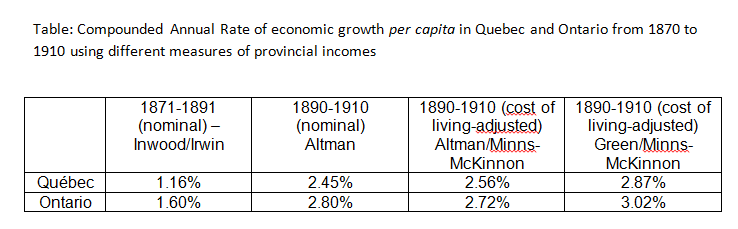
But what about Quebec’s first days in the Canadian confederation? I have had the chance to stumble on an article by Kris Inwood and Jim Irwin (2002) in Acadiensis which estimates, roughly, provincial incomes from 1871 to 1891 which I can combine to the existing estimates by Alan Green (1971) and Morris Altman (1988). Sadly, price indexes are not available for each province for such a long period. However, as one can see below, the trends all point in the same direction: Quebec suffers from an economic decline relative to Ontario regardless of the statistical series used from 1870 to 1910.
EconomicGrowthQcOnt

This table is heavy in implications. First of all, it means that economically, Quebec initially declined relative to the rest of Canada up to the First World War. Secondly, it means that at best, Quebec stagnated relative to Ontario during the interwar period. At worst, it continued to decline in relative terms but at a slightly slower pace than before. Third, this means that the rapid economic growth of Quebec from 1945 to 1960 that I document (faster than elsewhere in Canada, including Ontario) is a complete break from past trends. Had I known of the existence of the Inwood-Irwin dataset, I believe I would have added this table to my book. But now, it is said and it will be added to the “book section” of this blog in order to provide readers with “follow-ups”.


Economic History between Two Swimsuits

My recent book, Du Grand Rattrapage au Déclin Tranquille, is the subject of an article in the French-Canadian magazine Summum. For those who are not from Quebec, Summum is a “boys’ magazine” with tons of girls in swimsuits (or less). So I dare say I gave an interview to end up between two girls in their swimtrunks. Here is the cover and the article itself for which there are two addendas that I am adding at the end of this blog post:
photo (4) lyVQTKR photo (3)

Addenda 1: On the second page, it says “85 Quebecers had university degrees for every 100 Ontarians” – that is not the exact statistic. The proportion of Quebecers above 15 years of age who possessed university degrees in 1961 was equivalent to 85% of the same proportion in Ontario.

Addenda 2: A few lines below, it says that it high school participation declined while in fact it increased. The reporter merely inverted the terms, nothing bad.

On specialization in Quebec from 1760 to 1840: the case of Timber exports

In line with my previous posts on the growth of living standards in Quebec prior to the Act of Union of 1840, I have used statistics provided by Gregory Clark (Agricultural Prices in England since 1209) to derive an estimate of the value of timber exported from Quebec to England. Why such an estimation? Because it acts as a proxy for another field of interest to me: agricultural productivity.

As I have stated earlier, the conquest of Quebec likely included the colony within a safer network of international trade where economies of scale and increasing productivity allowed the colony to benefit from “smithian” growth (larger markets give more scope for specialization). If the existing literature is correct in labelling Quebec farmers as “traditionalists”(also labelled as “peasant mentality in reference to the inability to act in what economists would dub “rational behaviour) we should see that their inability to produce food more efficiently would make the cost of living dearer to workers who decide to seek employment outside the agricultural area. The “counterfactual logic” is that if farmers were inefficient, workers leaving agriculture would reduce the food supply and, without a drop in demand, increase the cost of living. This means higher prices to agricultural produces which would drive them back into the fold. If farmers are able to increase production and productivity, then workers will gradually be reallocated to more productive uses in other sectors of the economy (manufacturing, services, shipping etc.).

Yet, as we can see, the value of timber exported from Quebec (with the exception of the peak of the Napoleonic wars) rises steadily on an inflation/population adjusted basis. This suggests that there must have been some level of agricultural productivity growth because the workers involved in cutting, transporting, loading and shipping timber to England and elsewhere would have faced increasing food prices which would have offset the benefits of exiting agriculture.   As a result, the timber industry should have contracted, not expanded.

Timber

My point here is not new to economists and economic historians, it is new however for Quebec historians who have long been debatting (and who are still debating) whether or not (or the degree at which) Quebec farmers were “retarded” (I say this bluntly, because the debate is exactly that: were farmers unable to be rational and adopt welfare-optimizing behaviour?).

I argue that if these farmers were retarded and unable to increase productivity in a sustainable manner, other sectors of the economy could not have developped.

Here I may offer a proposition which I am still surveying in my own work: like the United States, Quebec did experience economic growth up to 1820 that was mostly the result of expanding markets (due both to increased shipping productivity and the oceanic domination (and security provided) of the Royal Navy). However, after 1820, institutional factors would be the main explanatory force in the divergence which began at that time between Lower Canada and Upper Canada and to a greater degree between Lower Canada and the United States.

Le chômage au Québec entre 1946 et 1960

Je relisais récemment les livres sur l’époque de la Grande Noirceur et j’ai réalisé que plusieurs mettent une emphase importante sur le taux de chômage du Québec. Malheureusement, je n’ai pas cette fixation sur cette statistique et je n’en ai pas parlé dans mon livre (même si j’en ai parlé ici). Pourquoi?

  1. Le chômage est une statistique dont la compilation est souvent assujettie à des dangers de définition;
  2. Le chômage peut être élevé dans une économie dont la structure se métamorphose rapidement. Dans ce contexte, les individus sont prêts à assumer le risque de quitter leurs emplois et déployer des frais (des « search costs ») pour trouver un emploi plus rémunérateur dans de nouveaux domaines. Ce chômage n’est pas nécessairement indésirable.

Concentrons-nous sur le second point principalement. Rappelons que les francophones au Québec étaient à 30% occupés dans le domaine agricole en 1941 contre à peine 12% en 1961. Les travailleurs auparavant occupé dans le domaine agricole ou celui des ressources naturelles ont migré vers le secteur manufacturier en grands nombres. Les francophones auparavant employés dans le secteur industriel ont migré vers le secteur tertiaire, la finance ou les professions libérales. Il y a donc une métamorphose importante de l’économie du Québec – particulièrement pour les francophones. Comme je le documente dans mon livre, le niveau de vie des Québécois augmente beaucoup plus rapidement qu’ailleurs au Canada au cours de cette époque. Et pourtant, le taux de chômage augmente.

Chomage

Mais voici, c’est ici que je pense que le point 2 devient valide. La part québécoise des chômeurs canadiens (tels que définis par la définition de 1946 dans les statistiques historiques) augmente constamment jusqu’à 1960. Cependant, lorsqu’on regarde la part québécoise des demandes d’assurance-emploi, elle demeure stable. En plus, elle est nettement inférieure à celle que le taux de chômage nous laisserait croire.

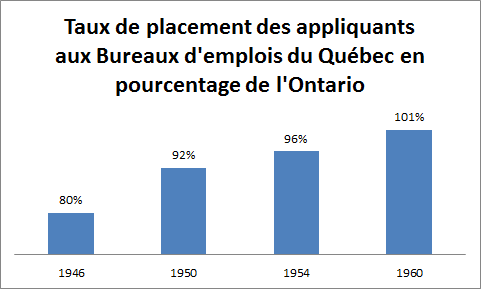
Alors, est-ce que mon hypothèse de changements structurels où les Québécois changent beaucoup d’emplois et de carrières – créant un chômage qui n’est que frictionnel – peut être défendue? Absolument puisque nous pouvons consulter les données produites par les Bureaux d’emplois du gouvernement fédéral. Ces agences servaient à « matcher » des chercheurs d’emploi avec des offreurs d’emploi. Le taux de placement (la division du nombre d’appliquant par le nombre d’appliquant ayant obtenu un emploi) augmente plus rapidement au Québec entre 1946 et 1960 et il surpasse celui de l’Ontario en 1960.

Placements

Ainsi, il y a raison de peu se soucier de la statistique du chômage surtout considérant que l’ensemble des indicateurs de la productivité du travail – documenté dans mon livre – montrent une tendance à la hausse et ce même si les heures de travail diminuent dans une époque où les impôts étaient les plus bas au Canada (les Québécois travaillaient donc moins de leur propre gré et non pas à cause de contraintes imposées par le gouvernement).

En conclusion: les Québécois s’enrichissaient, cherchaient les emplois les plus rémunérateurs parce qu’ils avaient des attentes de revenus à la hausse grâce aux changements qui se produisaient dans l’économie du Québec. Pourtant, ils travaillaient moins d’heures en même temps que la productivité par unité de travail augmentait constamment. Aucune raison de se soucier de la statistique sur le chômage pendant cette période.

Agricultural productivity in Québec 1762 to 1831

In answering to the questions regarding my book (in French), I discussed briefly what I was doing for my own doctoral research on Quebec’s economic growth between 1760 and 1840. As I stated, I do not agree with the presumption that there are “preindustrial culture” which prohibit welfare-enhancing behaviour and posits an inability to respond to market incentives on the part of “peasants”.

The ultimate test of my position (that peasants did maximize output) is to look at agricultural productivity. In the years I am interested in (1760-1840), there was a decline in piracy and a consolidation in the organization of overseas shipping which accompanied a great increase in shipping productivity. In turn this led to market integration on both side of the Atlantic – something well documented for the United States, but not for the Canadian colonies. By sheer virtue of “Smithian” growth (extension of market size), the scope for specialization expanded and allowed for returns in investing in agricultural productivity (especially by mixing crops in order to maximize the returns from subsistence farming measured in calories and the returns from commercial farming measured in monetary terms). So, the test is indeed agricultural productivity.
As of now, I have collected samples large enough to create consistent data sets of farms in Quebec to evaluate the evolution of productivity in agriculture. The most viable one I believe to have is based on two censuses for the area of Trois-Rivières – the third largest city in Quebec after the Conquest – for 1762 and 1831. Using calories produced by each crops harvested and the quantity of land used, I managed to derive the increase in productivity for agricultural operations in that area.

Below you will see the percentage figures of productivity growth. I will not publish the values in calories produced for I want to keep my data for myself until my thesis is handed back. But as you can see, productivity growth in Trois-Rivières agricultural operations stood somewhere between 19% and 27% between 1762 and 1831. This gives a compound annual growth rate ranging between 0.25% and 0.35%. This is a non-negligeable rate which is below the figure of 0.5% found by Winifred Rothenberg in her study of Massachussets agricultural productivity from 1771 to 1801 but in the same waters as the one observed for wheat production by Robert Gallman from 1800 to 1850.

Productivité<

Given that it is generally accepted that economic growth in America from the end of the revolutionary era to the early 1820s relied mostly on factors which increased the size of the markets (rather than on technologies and technique that shifted the production function upwards), this means that Quebec’s economic growth path before the 1830s could have followed a path quite similar to that of the United States. Such a possibility yields powerful implications for the literature on early Canadian economic growth. Namely, it means that the divergence that occurred at some point in the second half of the 1800s came not from the “cultural” explanations often presented (and rarely in an impressive manner) but rather from institutional factors.